Regulatory compliance
Our goal is to achieve regulatory compliance, in order to protect overall population health. We are open in our decision-making, and use a step-by-step approach to achieve positive health outcomes.
Learn about our cooperative approach to regulatory compliance. We’re focused on assisting operators, owners and licensees in meeting public health requirements.
Our goal is to achieve regulatory compliance, in order to protect overall population health. We are open in our decision-making, and use a step-by-step approach to achieve positive health outcomes.

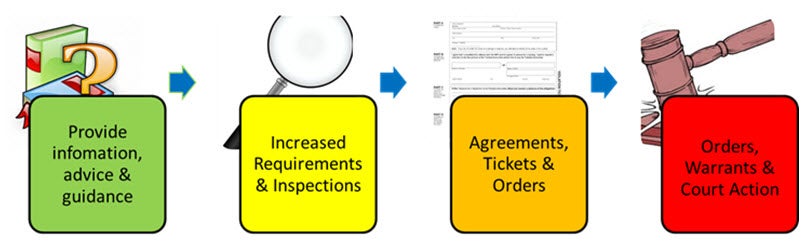
Our desire is to work cooperatively using a step-by-step approach. We focus first on providing guidance to assist operators, owners and licensees in meeting public health requirements. This figure provides examples of the various types of progressive compliance methods we use to achieve our goals.
We will:
The operator, owner or licensee often plays a big part in influencing the officer’s actions. When there is a good working relationship between the officer and the operator/licensee, the officer will usually have more confidence in the operator/licensee’s willingness to address health risk. The officer’s actions will lean towards being more cooperative, rather than being more “heavy-handed.”
When a situation results in a high risk to the public, officers may need to act more quickly and direct stricter requirements regardless of the relationship.
In the event that compliance cannot be achieved through other progressive enforcement means, Environmental Health Officers, Licensing Officers, Tobacco and Vapour Enforcement Officers and/or Medical Health Officers may issue tickets, orders, and/or proceed to court action, in order to achieve compliance and protect public health.
Please note: Visitors to this site are cautioned against interpreting the status of a particular facility based on a single piece of information. Conducting additional research, such as contacting the facility, reviewing documentation and publications available on provincial, Interior Health websites, including our Inspection Reports page may result in a more informed conclusion about a given facility.
This website conveys information which would otherwise be available by request through the Freedom of Information and Protection of Privacy Act of B.C. Every effort is made to keep the information up-to-date and ensure that it is accurate.
We are a diverse team of trained professionals who are skilled at assessing risks, and have specialized knowledge and experience applying public health laws to help ensure that facilities, people and communities are safe and healthy:
Review to the decisions reviews and reconsiderations here.
Thousands of volunteers of all ages work alongside our staff across our region. Read how volunteers are making a difference in delivering outstanding care.
/stories/volunteers-bring-kindness-comfort-people-we-serve
IH’s Healthy Community Development team worked with student nurses to help local governments make breastfeeding more supported and welcomed in communities.
/stories/breastfeeding-toolkit-helps-cities-support-inclusive-spaces
Talking to your teens about drugs shows you care they make safe choices—it doesn't encourage drug use. Here's how to have talks with an open heart and mind.
/stories/how-talk-teens-about-drugs-and-other-substances
Cottonwoods Care Centre coordinator Lia Sambrielaz has been sharing small acts of kindness at IH for 37 years.
/stories/we-are-ih-coordinator-motivated-help-long-term-care-clients
Our 9-part video series teaches about the purpose and importance of advance care planning (ACP) and why it gives peace of mind to you and your loved ones.
/stories/lets-talk-about-advance-care-planning-your-voice-your-choice
A funding initiative is helping the Cariboo Chilcotin Métis Association (CCMA) grow food security in ways that reflect knowledge, culture and community needs.
/stories/funding-helps-williams-lake-metis-community-support-food-security
Receive news, alerts, public service announcements and articles right to your inbox.