Breadcrumb
Patient Safety
Recognizing and responding to hazards, near misses, and adverse events helps you develop your best understanding of what happened, take action to minimize the risk and impact, and inform the disclosure process.
Reporting and responding to hazards, near misses and adverse events
When harm occurs, patients will have clinical, psychological, and practical needs. Providing and receiving healthcare requires a trusting relationship between providers (employees & medical staff) and patients. To ensure that you can support and treat patients and their families with dignity, respect, compassion and empathy, IH Patient Safety has developed an infographic outlining the standard approach when responding to harm.
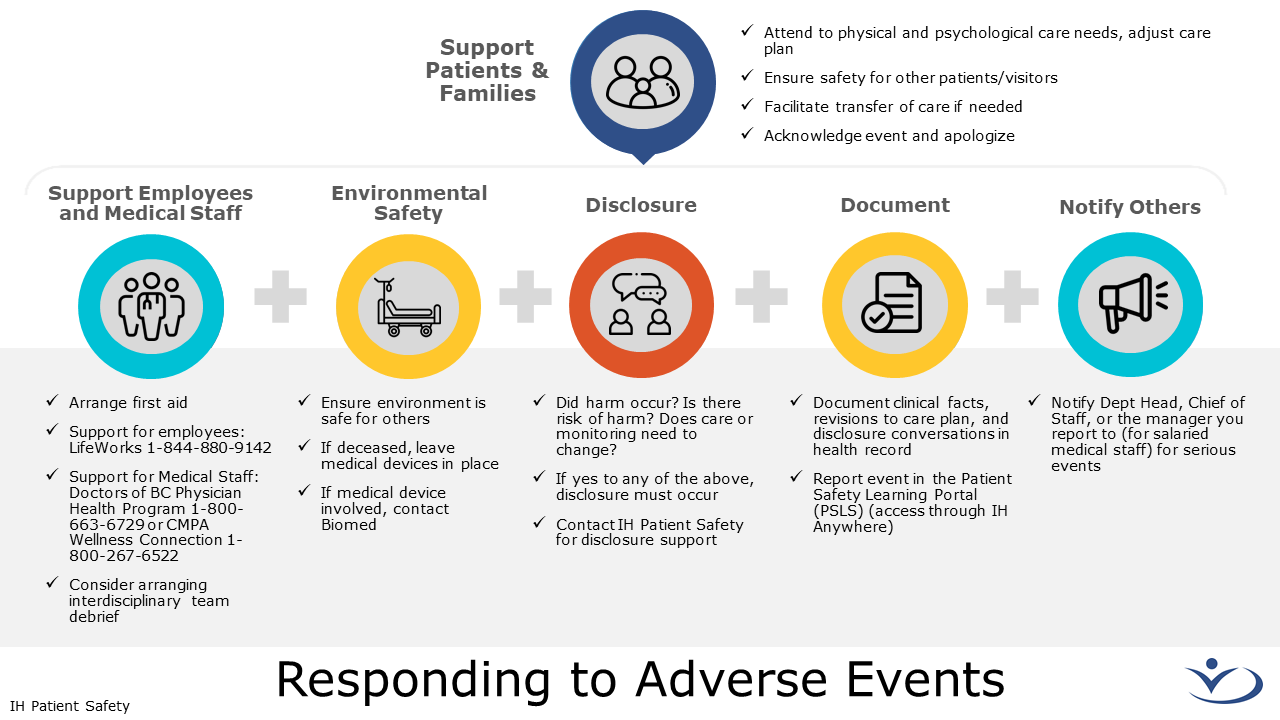
IH AK4000 Policy for Recognizing and Responding to Hazards, Near Misses and Adverse Events

All employees and medical staff are responsible to use the Patient Safety Learning System (PSLS) to report patient safety events to learn about and improve the quality and safety of patient care.
The PSLS is a provincial reporting system that enhances our capability to improve safety by capturing data and facilitating investigation and learning from hazards, near misses, and adverse events. Interior Health promotes a ‘just culture’ in which transparency, fairness, and appropriate accountability are considered as part of the focus on learning and improvement from these events.
PSLS reports are protected under section 51 of the B.C. Evidence Act. Medical staff can access the PSLS through IH Anywhere (our remote access solution). Once reported, the appropriate manager will be notified through PSLS of an event in their area.
Please access training and resources on the PSLS InsideNet page (requires Interior Health network access).
Witnessing or being involved in a patient safety event can cause intense emotional distress and create a lasting negative effect on the health and wellness of healthcare professionals.
After an event occurs, it is important to be compassionate and supportive of those involved by:
- Using a trauma-informed approach
- Avoiding making an assumption that a poor clinical outcome is the result of an error or poor judgment
- Avoiding making any premature or unsubstantiated remarks about professional competency
- Being aware of hindsight bias
- Following up with involved colleagues by offering support and referral to wellness programs as needed
Please note: A review needs to take place before there is any assignment of accountability to an individual, group or process.
When a patient has been harmed, is at risk of harm, or where care or monitoring needs to change as a result of an adverse event, disclosure by the provider is required.
You can find guidelines, algorithms, and access to coaching and training opportunities on the Disclosure InsideNet page (requires Interior Health network access).
Please contact IH Patient Safety (PatientSafety@interiorhealth.ca) to access 1:1 disclosure coaching and training.
Please note: Disclosure conversations must be documented in the health record.
IH Patient Safety (PatientSafety@interiorhealth.ca) can provide 1:1 support for medical staff managing events that result in serious harm or death. You may be invited to share your perspective of an event:
- through an interview with a Patient Care Quality & Safety Consultant, or
- by participating in a discussion as part of the serious adverse event review process
Please access guidelines and resources on the Adverse Event Response InsideNet page (requires Interior Health network access).
Section 51
Section 51 of the B.C. Evidence Act provides health care professionals with an opportunity to have open and honest conversations about the quality of care in hospitals without fear that the information can be used in civil litigation. It is intended to support quality improvement while contributing to a positive culture of safety within an organization.
Please access best practices, templates, information and resources on the Section 51 InsideNet page (requires Interior Health network access).
Jonnathan Quintero leads with curiosity and compassion, advancing patient safety, collaboration and quality improvement at IH.
/stories/we-are-ih-biomedical-engineer-recognized-nationally-patient-safety
Indigenous Patient Navigator Deb Donald has spent time in nearly every area of Royal Inland Hospital. There are few places in the hospital she hasn’t been.
/stories/we-are-ih-indigenous-patient-navigator-proud-help-her-people
As a young child, Julie Davenport struggled to be understood. Now she oversees Early Childhood Development programs, thanks to a speech-language pathologist.
/stories/how-speech-language-therapy-opened-doors-ih-director
Learn how to stay safe in B.C. waters when blue-green algae blooms, or cyanobacteria, are present.
/stories/why-you-should-avoid-water-blue-green-algae-blooms
Moved by her son's health journey, Alana Haynes found her calling helping young patients at Kelowna General Hospital feel more at ease and parents reassured.
/stories/new-child-life-specialist-enhances-pediatric-care-kgh
Cheryl Whittleton’s 40-year IH career spans bedside care to senior leadership, grounded in compassion and a commitment to strengthening the future of nursing.
/stories/we-are-ih-nursing-allied-health-officer-sees-bright-future
STAY CONNECTED
Receive news, alerts, public service announcements and articles right to your inbox.