Breadcrumb
Air Quality
Learn how to check the air quality in your area. Discover our role in ensuring the air you breathe is safe and find out the role you can play.
Monitoring air quality
We provide assistance to ensure the air you breathe is safe. Contact your regional Environmental Public Health office for assistance and information on how to respond to air quality issues.
Pay attention to the air quality in your area and monitor your symptoms regularly:
- Air Quality Health Index: Current and predicted, and health messages for the at risk and general population. If you live somewhere without an Air Quality Health Index, please refer to the following Canada PM2.5 map to view a combination of regulatory and low-cost monitor measurements of PM2.5.
- B.C. Air Quality: Current air quality advisories, levels of measured parameters and smoke predictions.
- Forest Fire Air Quality: For more information about forest fires and your health, visit our Emergency Preparedness webpage.
Environmental health officers can help you find information about indoor and outdoor air quality.
Indoor air quality
Poor indoor air quality may be a symptom of another problem such as mould caused by water intrusion or poor ventilation within a home. Our office does not test for specific airborne contaminants.
Air quality issues related to places of employment are addressed by WorksafeBC.
Radon gas
Radon gas is the second leading cause of lung cancer after smoking. Radon is a naturally occurring gas found in the ground throughout the world. Most homes that are in contact with the ground will contain some amount of radon gas.
Outdoor air quality
Outdoor air quality issues are regulated by the BC Ministry of Environment and Climate Change Strategy and the BC Ministry of Health. The Ministry of Health makes recommendations on standards, objectives and regulations on outdoor air quality affecting human health. The Ministry of Environment monitors air pollution through approval processes, permits, regulation, guidelines and codes of practice.
Your role in improving air quality
There are a number of things you can do to help improve air quality:
- Avoid idling for more than 10 seconds. Keep your vehicle tuned and running efficiently.
- Drive less. Try taking the bus, carpool, walk or cycle.
- When buying a new car, choose a fuel-efficient one (e.g. a hybrid). Choose a smaller car, if possible.
- Avoid using gas-powered tools, such as lawnmowers, leaf blowers and trimmers. Use push mowers, electric mowers and even modern gas powered models, if possible.
- If you heat using a woodstove, use the latest emission reduction technologies. Always use dry seasoned wood, cut it into small pieces and keep your stove and chimney clean and in good working order. Upgrade your woodstove to an efficient, low emissions model.
- Avoid burning prunings and garden waste – compost them instead
- If you must burn, wait for a good venting Index (close to 100)
- Plant a tree
- If you think you may be affected by poor air quality, contact your physician for advice
Resources
Travel nurses Michaela and Nick moved from Ontario to B.C., finding careers, community and a new home in Coldstream.
/stories/travel-nursing-brings-ontario-couple-new-home-coldstream
By sharing his story, Dave hopes others struggling with addiction understand that recovery is possible and that support is available.
/stories/what-worked-me-daves-healing-journey-addiction
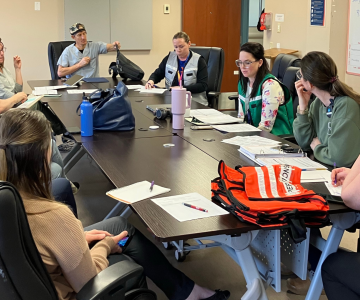
For IH, wildfire preparedness is shaped by years of experience, regular training, exercises, inventories and relationships with partners across the region.
/stories/ih-prepares-wildfire-season-long-smoke-arrives
IH’s CMH redevelopment team travelled around Cariboo to reconnect with Indigenous communities and share how their input is shaping the hospital's new building.
/stories/closing-circle-indigenous-communities-shaping-future-cmh
Chris Turner turned to addiction as a teenager, but through his recovery has become a mentor to give hope to others battling addiction.
/stories/what-worked-me-chriss-focus-daily-skills-helps-recovery
Find tips for walking, biking or rolling to school safely. Learn how to make it safer to travel to school in your community.
/stories/how-walk-bike-or-roll-school-safely
STAY CONNECTED
Receive news, alerts, public service announcements and articles right to your inbox.