Smoke-Free Environments
Find out about the importance of promoting smoke and vaping-free environments, access resources for communities and learn about IH’s smoke-free policy.
Local governments
Creating smoke-free environments is a great way to improve the health of your community. Smoke-free outdoor spaces are highly effective in helping children and youth grow up to be non-smokers. These environments also support people who are trying to quit. Communities with smoke-free bylaws have lower smoking rates, less toxic litter that can be swallowed by children or pets, and fewer wildfires.
The Legal Substances Team can provide support and consultation to communities interested in reviewing or implementing a smoke-free bylaw. Please connect with a Legal Substances Reduction Coordinator via email for more information.
The Tobacco & Vapour Enforcement Team is responsible for conducting routine retail inspections and compliance checks. Please connect with a Tobacco & Vapour Enforcement Officer via email with any questions or to report any tobacco and vapour retailer contraventions.

Public support for smoke-free outdoor areas is on the rise. This is not surprising, as more than 85 per cent of British Columbians do not use tobacco. In fact, more than 60 communities in B.C. have restrictions on smoking in public spaces that are stronger than the provincial Tobacco and Vapour Products Control Act.
- Large and small communities have restricted smoking in outdoor public places: Kelowna, Salmon Arm, Penticton, Nakusp and Osoyoos, among others
- Residents support smoke-free bylaws and communities that have adopted them report minimal public pushback or burden on enforcement
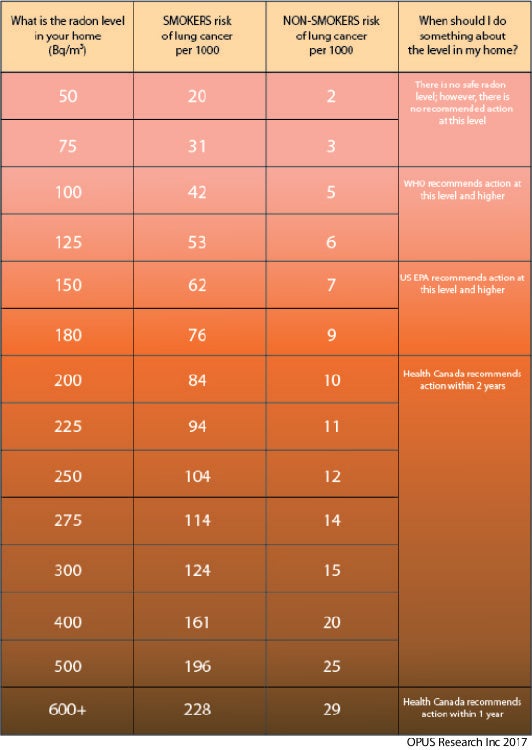
Health Canada estimates the risk of lung cancer for people exposed to both tobacco smoke from smoking and radon gas is one in three. This is much higher than just smoking or just being exposed to radon (see table showcasing risk of lung cancer). Radon is a natural gas that gets trapped and built-up inside buildings, such as your home, to levels that are harmful to your lungs. Knowing this, you can reduce your risk of lung cancer by either stopping smoking, or by reducing the level of radon in your home, or both.
Radon is an invisible, odourless and tasteless gas that comes from soils that naturally contain uranium. Radon gas enters a building through cracks and small holes in the foundation. The only way to know the level in your home is to complete an easy, relatively cheap test for radon. Actions to lower radon levels, and your overall risk of lung cancer, are relatively easy to achieve and inexpensive.
Your risk of lung cancer will be lowered the most by stopping smoking and reducing radon levels.
- Smoke Free Bylaws - Factsheet for Local Governments | Interior Health
- Policy Resource Hub | Action on Smoking & Health
- Tobacco Reduction | PlanH
- The Harmful Effects of Second-hand Smoke | HealthLink BC
- Radon Action Guide for Municipalities | Health Canada
Schools
All public and private kindergarten to Grade 12 schools in B.C. are tobacco and vape-free under the Tobacco and Vapour Products Control Act and Regulation. This ban extends to all school property 24 hours a day, seven days a week, regardless of whether or not school is in session. The ban includes vehicles, parking lots, sports fields, driveways, courtyards and private vehicles parked on school property.
Interior Health properties
Interior Health is committed to promoting and protecting the health of our patients, employees and residents of the communities we serve. IH’s Smoke-Free Environment policy means that smoking and vaping are not permitted on our owned and/or operated premises, facilities, grounds and vehicles.
Here is what it means for you:
- We ask visitors and outpatients to not smoke cannabis, tobacco or use e-cigarettes while on our property. This help us provide a safe and healthy environment to all people that we serve.
- Patients in hospital who smoke or vape can access free nicotine replacement therapy to remain comfortable during their stay
- If you are an Indigenous patient and interested in the traditional use of tobacco, please discuss it with your IH Indigenous Patient Navigator
- Talk to your doctor or health-care provider if you would like assistance managing your tobacco and vaping use or quitting
IH Smoke-Free Environment policy | Interior Health
IH Indigenous Patient Navigator | Interior Health
Tobacco & Vaping Facts and Stats | Interior Health
Quitting Tobacco or Vaping | Interior Health
BC Smoking Cessation Program | Provincial coverage for quit aids | BC Ministry of Health
QuitNow | Provincial quitting and reducing program (free) | BC Lung & Government of BC
Inspired by the strength and openness needed to care for families during one of life’s most transformative moments, Rachel pursued a career in health care.
/stories/we-are-ih-midwifes-journey-care
Hantavirus is a rare but serious disease caused by inhaling hantaviruses in old rodent droppings or urine. Learn how to protect yourself while cleaning.
/stories/cleaning-shed-attic-cabin-or-barn-protect-against-hantavirus
Living well at home as you grow older is possible with some forethought and planning. Explore IH services and community resources that support you in your home.
/stories/how-live-well-home-well-your-senior-years
Two new modular homes have arrived at Sunnybank Retirement Centre, marking a major step in the Town of Oliver’s Housing for Healthcare Workers Initiative.
/stories/new-modular-homes-oliver-support-health-care-workers
When Dr. Elena Schroeder decided to pursue medicine, her goal was to always learn and grow. Today, she’s a leader helping shape the future of health care.
/stories/we-are-ih-cranbrook-hospitalist-continues-learn-and-grow
If you’re concerned about your child’s communication skills, the earlier they see a speech-language pathologist, the better the outcomes—and it’s free.
/stories/your-child-never-too-young-see-speech-language-expert
STAY CONNECTED
Receive news, alerts, public service announcements and articles right to your inbox.