Explore Stories
Community & Culture
Two registered nurses from Royal Inland Hospital (RIH) proved Saturday that love will prevail even in the time of COVID-19.
When Amanda McKay and James Futerko couldn’t have the wedding of their dreams, they chose a different option that honoured their colleagues and the workplace where they met.
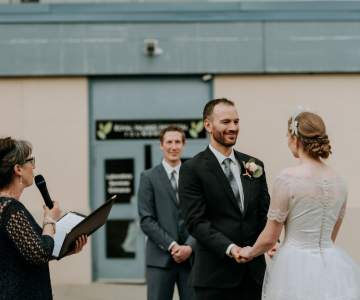
On Saturday, standing before a marriage commissioner in the roundabout traffic circle at RIH, the couple exchanged vows in front of family and friends, all positioned strategically apart from each other.
As a slight wind blew and vehicles came to a standstill, guests watched from around the sidewalk and the second, third and fourth levels of the parkade. When the ceremony ended, a loud cheer went up and applause broke out – the cloud of the pandemic momentarily forgotten.
It was a fitting start for the marriage of Amanda, an Emergency and Intensive Care Unit (ICU) registered nurse, and James, an registered nurse on the High Acuity Response Team, who met on the job at RIH in 2017 when Amanda was filling a temporary position in the ICU.
“We were going to get married in Chilliwack on James’ family farm. When the pandemic started, we realized we had to do something different, but also something special,” said Amanda.
Someone joked they should get married at the hospital and the idea, amusing at first, took on the grains of a possibility that became a reality with the support of Interior Health and RIH leadership.
L-R: Matt Stubbings, Richard Jewitt, bride and groom and Shanta Rishy-Maharaj. Photo courtesy of Captured by Nicole Photography.
“We were happy to support Amanda and James in holding their wedding on site,” said Richard Jewitt, RIH clinical director who oversees the Emergency Department. “It is important to recognize that positive events can take place at this time, even as we adhere to public health standards such as physical distancing.”
For Amanda and James, the unusual wedding location meant they were getting married at a place close to their hearts.
“I really love working here,” said Amanda. And despite COVID-19, the timing was perfect.
Two nurses getting married during National Nurses Week, in the Year of the Nurse, and in the midst of the biggest health emergency since 1918.
How they got engaged
James and Amanda are avid mountain bikers and they prefer that special events reflect what they value in their lives. So, last September James made a plan.
He got a ring and arranged a bike ride up Vedder Mountain in Chilliwack on a date he hoped would be a perfect fall day. They woke up to pouring rain and cold wind. Fortunately, Amanda is a hearty type – as nurses tend to be. With no hint of what was ahead, she agreed to put on her rain gear, climb on her bike and away they went, the weather getting worse all the time. Splashing uphill through mud puddles, they arrived at the location James had in his mind for his proposal.
He turned on the music in preparation to pop the question, but other cyclists at the same spot delayed him. So he asked her to dance – which they also both love to do – in the mud instead. They danced through his proposal song, “Georgia,” and then the coast was clear. He acted quickly, getting down on one knee and while a song played that neither can even remember now, he asked her the question.
The shocked and muddy bride-to-be asked, “What? This is happening now?” And then she said yes.

Health & Wellness
Cancer treatment can be one of the most exhausting emotional and physical experiences, both for the person living with it, and for their family.
Now imagine the added anxiety and complexity of needing care during the COVID-19 pandemic, and that exhausting experience has just become even more challenging.
While cancer care teams across Interior Health have worked tirelessly to protect these vulnerable patients, Dr. Phillip Malpass, a community oncologist from Nelson, realized he could take additional steps to support his patients while being mindful of COVID-19 precautions. He quickly pivoted his care model to incorporate virtual care for some of his patients.
“As physicians, we always strive to bring care closer to home. Virtual technology allows us to bring that care right to patients – in the comfort of their community, and in the comfort of their home,” says Dr. Malpass.
Dr. Phillip Malpass
Although exploring and expanding options for virtual care is not a new concept in Interior Health, the challenges brought on by the COVID-19 pandemic has quickly moved the concept to the forefront for care providers across the region.
The option of virtual appointments allows Dr. Malpass’ patients the option of having additional family members or caregivers also participate in appointments – increasing their comfort and allowing them the support they need, when they need it.
It’s all about removing obstacles to care, he says. Because of technology, his patients (especially those in rural areas) are able to reduce travel, save time, and spend less effort and money getting to appointments. These things can make a significant impact on people who may be feeling unwell, and impacts families already struggling to provide care and emotional support.
Beyond patient visits, Dr. Malpass also uses virtual technology to connect with the multidisciplinary team with whom he meets regularly. This allows the team to collaborate and provide a cohesive circle of care for people living with cancer, all while observing social and physical distancing and keeping safe themselves.
Dr. Malpass’ commitment to the virtual approach is more comfortable for patients and for staff – and it’s resulting in safe, quality oncology care in the Nelson area.
Community & Culture
When Williams Lake physician Dr. Ivan Scrooby and infection prevention lead Kelly Dillon were walking through a partially-remediated area of Cariboo Memorial Hospital (CMH) in Williams Lake earlier this year, inspiration struck.
The two were inspecting an area of the hospital that was already under construction and included ambulatory care, part of patient registration and the cardiology department. The area had been damaged by floods in January, the result of a series of burst pipes due to severe cold temperatures, and a negative pressure system was in place to remove construction dust from the area.
Due to the construction, the area was already cordoned off and completely separate from the rest of the hospital; the area was fully enclosed and fans were moving air outside as part of the remediation work.
At that time, the COVID-19 crisis was just beginning and hospitals had been asked to postpone surgeries and prepare for what could be an increase in patients who were ill due to COVID-19. Dr. Scrooby and Kelly immediately saw an opportunity to create a protected patient care area that would help limit the virus from spreading throughout the rest of the hospital.
“We went down together to have a look at the repairs and, when we walked through the space, we realized it had the potential to become a negative pressure space without having to do too much work,” says Dr. Scrooby, who inquired of the contractors if the negative pressure system could remain in place.
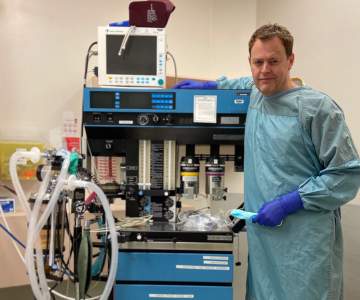
Cariboo Memorial Hospital in Williams Lake created a negative pressure area to allow staff to treat patients with COVID-19.
“From there the idea grew and we worked with our team at CMH and the contractor to make a few more improvements so we would be ready for potential COVID-19 patients.”
“Our departments had already been juggled around because of the flood repairs,” says Thalia Vesterback, CMH Director of Clinical Operations. “The silver lining was we had already looked at space utilization and that space that was under construction in our pandemic planning. It was a perfect solution to use the space that was being remediated due to the floods.”
* * *
During a particularly frigid cold snap in January, CMH was hit by a series of burst pipes and the hospital was thrown for a loop with its main, emergency and temporary public entrance all having to close down during the same week.
Temperatures had plunged below minus-30 C. Pipes were failing and water leaked throughout the hospital. The main water system to CMH had to be shut down. A few services became unavailable but, through it all, patient care wasn’t impacted.
“We had five separate pipes burst over a week and it kind of became like Groundhog Day, with staff responding all over again every day, in all of the different units,” says Thalia. “It really did bring everyone in the building together and there was just exceptional teamwork from all of our staff and physicians.”
Once the temperatures rose above normal, it was time for remediation work to begin. A large area was hoarded off as a restoration company worked to repair areas that were damaged. As repairs were nearing completion, hoarding remained up and a negative pressure system was in place to protect staff and patients from any construction dust. It was then that the province was hit with the COVID-19 crisis.
Enter Dr. Scrooby and Kelly Dillon's light-bulb moment. When the contractor returned to CMH to complete the restoration work, a few tweaks were made to the area. Two separate staff entrances were established where physicians and nursing staff could enter and don Personal Protective Equipment (PPE), and then exit when treatment was complete. Patients would also have a separate entrance, maintaining isolation protocols during the COVID-19 crisis.
“We are eternally grateful for all of the team players that made this happen,” says Dr. Scrooby. “It’s very comforting to treat patients that are very sick in the unit because we know we are limiting the exposure risk. With the staff and physicians wearing the proper PPE, we are protected, and so are the staff and the patients that are admitted into the regular hospital. I want to extend my gratitude to everyone for all of their hard work. We are serving a large rural community so it’s a bit challenging at times, but this has gone a long way in helping us if we have an outbreak to deal with.”
“This is just one more example of how amazing our health-care team is at Cariboo Memorial,” adds Kelly. “We work hard every day and it shows.”
Thalia echoed both of those comments, heartened by the way everyone pulled together, not only at the start of the COVID-19 response, but to the flooding earlier in the year as well.
“I think everybody has been fabulous, they have been amazing,” she says. “Everyone just pulled together. It started with the flooding and people chipping in and asking ‘how do we do this?’ Everyone was willing to come together and discuss solutions to the problem. It was a lot of effort from so many people and it really ended up being a great thing.”
Community & Culture
Medical students based at the UBC Okanagan campus in Kelowna are helping front-line physicians in the battle against COVID-19 in the B.C. Interior.
With the temporary suspension of clinical training in hospitals and clinics across the province, many medical students began looking for other ways to support physicians and patients during the pandemic.
Over 80 students joined the B.C. COVID-19 medical student response team, a UBC student-led initiative supporting physicians and volunteer projects in all regions of the province.
“Volunteering is a tangible and effective way to make a difference,” says Alex Monaghan, medical student and volunteer organizer. “We wanted to get involved out of appreciation and gratitude for those working to keep us protected and safe.”
From providing childcare and personal assistance to physicians, to supporting patients remotely, students have rallied together to offer their support across the Interior Health region.
Students have helped configure tablets with video messaging applications to help patients at Kelowna General Hospital (KGH) stay connected with their families. They also recently launched a meal preparation and delivery service to support physicians and their families.
“As we adjust, both personally and professionally to the new realities of life with COVID-19, I’m deeply encouraged by the generosity and solidarity of this newest generation of future physicians,” says Dr. Sarah Brears, Interim Regional Associate Dean for the Southern Medical Program and family physician. “The extra support they’re offering to the community is helping many physicians stay focused on their work and their patients.”
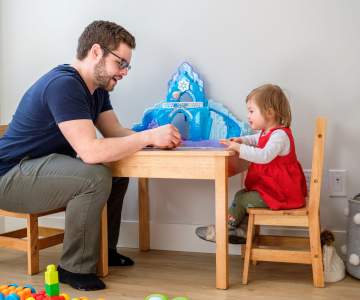
Medical student Brian Hayes is one of the volunteers helping out by entertaining the busy 18-month old of a local physician working at KGH.
For Hayes, volunteering is a small way to give back during an unprecedented time.
"As individuals committed to providing care to the public, we have a strong desire to assist those on the front lines,” says Hayes. “Volunteering our time to support physicians with an inflated workload or help with projects such as contact tracing allows us to be engaged in the COVID-19 response."
As the COVID-19 pandemic continues to evolve, students remain committed to volunteering with projects that can support physicians, patients, and the health-care system as a whole.
“We chose medicine because we have a deeply ingrained desire to make a difference in the lives of those around us,” says Monaghan. “Those values don’t disappear just because there’s a pause in our clinical training. We’re here to help in whatever form that takes.”
Reprinted with permission from The University of British Columbia, Okanagan Campus
Community & Culture
One year ago on April 29, Maureen Thomson was sitting at a desk inside the new David E. Kampe Tower at Penticton Regional Hospital (PRH), looking over a set of computer screens, each one flashing patient names and locations.
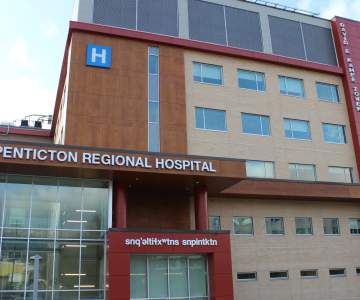
At the time, Maureen was the health services director and responsible for moving some 65 patients from their hospital rooms to new single-patient accommodations inside the David E. Kampe Tower. The tower, a six-storey addition to PRH that also included a parkade, was ready to open its doors to the public.
Construction had begun in 2016, while planning had taken place for many years prior. It was the culmination of a four-month period known as 'operational commissioning', the period after construction completed and Interior Health had moved in equipment, trained staff, and ultimately moved patients from the older building into the new tower. Years of hard work were coming together in one emotional day.
One year later
Fast forward a year.
The new building is all that was expected, and maybe more. Since the earliest days of planning, it was felt the state-of-the-art tower could change the way health care was delivered at PRH, impacting patients not only in Penticton but right across the region.
According to Carl Meadows, a senior leader in acute and community care in the South Okanagan, it has done just that. “The tower has had a huge impact on patient care for residents of the South Okanagan and Similkameen. There is so much more space right from the main entrance to the clinics and into the single-patient rooms. We are thrilled to have this building as a jewel of health care. It really allows our staff and physicians to thrive and provide exemplary care for patients. It’s a great healing environment for patients, something David Kampe himself was extremely proud of.”
In fact, Mr. Kampe, the philanthropist who donated millions of dollars towards the tower which bears his name, often told Carl that he wanted the hospital to be like a five-star hotel.
The opening ceremony of the new tower included David Kampe and other key members of the PRH project including Dr. Brad Raison, Maureen Thompson and Carl Meadows
When he passed away shortly after the tower opened, the hospital received his Order of B.C. which honoured Mr. Kampe for a lifetime of charitable work. The Order now hangs in the hospital, alongside a stunning array of artwork and sculptures.
And it’s not only the art that adorns seemingly every hallway that makes it unique: Aboriginal signage outside the hospital's main entrance, at patient registration, and elsewhere, welcomes visitors and patients in the traditional Syilx language of the Penticton Indian Band, honouring the knowledge keepers of the land.
“We are just so proud of this facility,” says Carl. “So many people played a key role. It was an immense amount of work and a credit to our staff and physicians that we kept PRH operating the whole time and kept putting patient care first. This is a building that matches the skill and compassion of our staff and physicians.”
Dr. Brad Raison was the Chief of Staff at PRH during the planning, construction and opening of the David E. Kampe Tower. He says the tower has brought positive change but stressed there is more work to be done. “We have seen many positive changes at PRH such as nuclear medicine, a permanent MRI, and single patient rooms," says Brad. "This is merely the beginning. Medicine is constantly changing and with it the need for more and new tools to support these changes. We must continue to build on what we have started. Today’s dreams can be tomorrow’s reality.”
Through the eyes of a patient
When Graham Tungate entered the doors of the David E. Kampe Tower earlier this year to prepare for surgery, the 77-years-young Penticton native was feeling some of the anxiety that goes with any impending procedure. However, the atmosphere in the Kampe Tower put him at ease. “In spite of the continual activity, what is noticeable is the quiet,” says Graham. “The design has allowed an ambiance of peace, quiet and comfort to develop.”
The new coffee shop and the heritage photographs on display also helped to take his mind of the impending procedure.
Beyond the calm and welcoming atmosphere, something else stood out for Graham. “I have to mention something very important that directly affected me as a patient: The culture of the medical staff. It is a team culture and like all good, successful teams, it generates its own energy, which is greater than the sum total of the parts,” says Graham. “The medical staff have high standards, they have pride in their work, but more important than that, they care. They have kindness and compassion. Each time that I leave the tower I feel proud that, as Canadians, in our quiet, modest way, we got it right.”
In the end
The opening of the David E. Kampe Tower marked a new beginning for Penticton Regional Hospital. The discussion began long ago among local decision makers to push for a new hospital in Penticton. Years of planning, detailed design work and collaboration occurred between PRH staff and physicians; Interior Health Capital Planning; the Ministry of Health; funding partners like the SOS Medical Foundation and the Okanagan Similkameen Regional Hospital District; stakeholders including the Penticton Indian Band; and contractor EllisDon Infrastructure.
Construction work is expected to conclude in 2022 with a modernized and much larger Emergency Department among the changes.
For Maureen Thomson, who has since retired, it was all about the team. She says everyone involved deserves part of the credit. “This was one of the most remarkable team-based initiatives that you could possibly have,” she says. “Our staff and physicians put their heart and souls into the work and it’s completely evident in the results of the tower.”
On opening day, April 29, 2019, as patients were expertly relocated and an army of volunteers moved hospital beds, cleaned equipment and helped patients, Maureen sat back in awe of what had been achieved. “You don’t get many times in your career that you have the joy of being associated with such a remarkable process,” she says.

Community & Culture
Dealing with a severe speech disorder and transitioning from hospital to home was more than enough for the Freeborn family to cope with. Adding COVID-19 to the mix and hospital visitor restrictions, and problems could have easily gone from bad to worse.
Despite those challenges, this family was able to find a way around those obstacles, with the help of Kelly Talbott, a speech language pathologist at Kelowna General Hospital (KGH).
Larry Freeborn was in hospital dealing with Wernicke’s aphasia, a disorder which makes it difficult for him to understand the meaning of spoken words and sentences. This condition also makes it a struggle for him to use words to express himself in a meaningful way.
Earlier this month, Larry was finally well enough to go home. Prior to leaving KGH, Larry and his family needed help figuring out how to communicate with each other. But with physical distancing regulations at the hospital, the ideal process of face-to-face education in the same room was not an option.
So Kelly devised a work-around to help this family get the support they needed at a critical time in their lives. In the days leading up to Larry’s transition home, Kelly joined his family from a safe distance on their daily visits with Larry though a hospital window.
Through the window, she demonstrated the techniques this family would need to be successful communicating with each other.
Although life inside and outside the hospital is not what it used to be, creativity and a people-focused approach made a big impact in the lives of this family.

Health & Wellness
Is there an older adult in your life? Staying connected despite social distancing can be a real challenge.
Health & Wellness
More than four years ago B.C. declared a public health emergency in the face of unprecedented overdose deaths.
Since that time, more than 789 lives have been lost within the Interior Health community.
Important progress has been made and the evidence is promising. Research from the BC Centre for Disease Control shows that harm reduction efforts are saving lives.
"While the number of overdose deaths declined from 2018 to 2019, there are still countless families reeling from the unfathomable grief of losing a loved one. Now, we are facing a global pandemic on top of a fentanyl-poisoning crisis." -- Judy Darcy, Minister of Mental Health and Addictions
Some of the ways we've been working to reduce overdose deaths in our communities are:
Introducing overdose prevention services and mobile supervised consumption servicesImproving our ability to track overdosesParticipating in the B.C. Take Home Naloxone programEnhancing access to opioid agonist treatmentsExpanding mental health and substance use services, such as increased outreach and follow-up efforts Last year the Burning Bright candle display commemorated the anniversary of the overdose crisis and marked the number of lives lost to overdose.
“In this unprecedented time of two public health emergencies, we must work together to both flatten the curve and stop overdose deaths. We cannot afford to stop caring about one health-care crisis as we stare down another. -- Judy Darcy, Minister of Mental Health and Addictions
Interested in learning more? Read the Minister’s statement about the ongoing overdose crisis and the challenges of having two health emergencies.

Health & Wellness
Penticton resident George Garland has a deep and personal connection to health care in the South Okanagan. His beloved wife Marie spent quite a bit of time at Penticton Regional Hospital while receiving care for Parkinson’s disease and her other health issues.
In memory of Marie, George has donated $100,000 for medical equipment at Penticton Regional Hospital.
George says he was smitten with his future wife Marie almost from the moment he met her at an Edmonton diner more than 66 years ago. In the early 1950s he was working as a heavy equipment operator in Edmonton and often had dinner at the same café where Marie worked as a waitress.
”I used to eat there nearly every night,” George says. “Our first date went well and we hit it off.”
The couple moved to Penticton in 1991.
Several years later, Marie’s health started to decline. “She spent quite a bit of time in the hospital. At one point the doctor took me to the chapel and said he didn’t think she would make it, but she pulled through,” says George.
In her later years, Marie also suffered from Alzheimer’s. She passed away at a care centre in Summerland in September 2018.
George’s donation to the South Okanagan Similkameen Medical Foundation will go a long way towards helping patients at Penticton Regional Hospital. Construction is already well underway on the second phase of the hospital expansion, including a major upgrade to the Emergency Department scheduled for completion by the fall of 2021.
Marie and George
-
Load More
Showing 810 of 836
Sign up for email updates