
Breastfeeding toolkit helps cities support inclusive spaces
Breastfeeding and human milk are not only important for the health and well-being of babies, but for parents, families and communities.
While most parents can breastfeed newborns, many families face barriers and lack supports. These barriers may shorten how long a parent breastfeeds and contribute to lower breastfeeding rates.
Public spaces can pose challenges
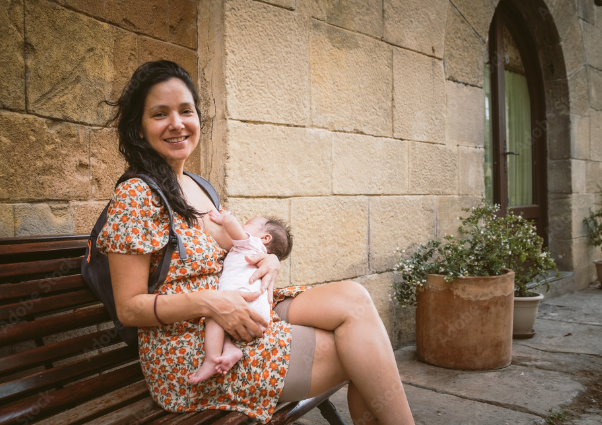
Public spaces are not always designed to support breastfeeding and can be challenging for parents to navigate. Social attitudes can also make parents feel wary of feeding in public.
“Parents have a right to breastfeed anywhere, but that doesn't always mean they feel comfortable or welcome to do so,” says Kelly MacDonald, a community health facilitator with the Interior Health (IH) Healthy Community Development (HCD) team.
Kelly co-led the development of a resource aimed at making public spaces more inclusive of breastfeeding parents, alongside fellow community health facilitator Tanya Osborne and public health dietitian Karen Graham.
Their work focuses on changing the environments that support breastfeeding success beyond the hospital and clinics, into everyday community spaces.
“It's not about creating special rooms: it's about making space for everyone in a community, including parents who are breastfeeding,” says Tanya. “It's really about equity and inclusion, and that matters for parents, babies and community well-being.”
Toolkit supports local government efforts
The Breastfeeding‑Friendly Public Spaces Toolkit was created to tackle these challenges head‑on. Built from evidence, best practices and insights shared by local governments, the toolkit gives communities practical ways to make breastfeeding more visible, supported and welcomed.
It helps local governments look at their spaces through the eyes of breastfeeding families—asking what gets in the way, what helps, and how small changes can make a big difference.
Community health facilitators like Kelly and Tanya work with municipalities to help find welcoming spaces across the city for breastfeeding purposes.
The City of West Kelowna is one municipality that has collaborated with the HCD team.
“As a mom who raised my children here in West Kelowna, I know how important it is for families to feel comfortable and supported in their day-to-day lives,” says Melissa Hunt-Anderson, Community and Social Development coordinator with the City of West Kelowna.
“In my role working on the City’s Community Safety and Well-Being Plan, I see this as an important part of building a community where everyone feels safe and respected. Creating breastfeeding-friendly spaces is one way we can help ensure everyone feels welcome in our community.”
The Healthy Community Development team supports communities through Breastfeeding‑Friendly Public Spaces Toolkit and other community‑based initiatives. These are designed to embed health and equity into everyday local decisions—from policy development to built environment design—by applying public health evidence in real‑world settings.
Nursing students co-create resources
This breastfeeding project has been supported by municipalities as well as nursing students from UBC Okanagan (UBCO) and Thompson Rivers University (TRU).
Guided by a number of community health facilitators on the HCD team, the students provided the foundational research literature to support the toolkit.
They co-developed the Checklist for Breastfeeding-Friendly Locations, created marketing and engagement materials, and worked directly with businesses and service providers, such as libraries, to promote breastfeeding‑friendly practices.
“As students, we had the ability to spend time creating relationships with organizations within our community to develop an awareness of the toolkit and checklist,” says TRU student participant Kaitlyn Fleury. “And in turn be able to implement the strategies from the toolkit in public spaces in our community.”
Nursing students like Amanda Rempel, also from TRU, wanted real-life experience in the world of maternity care.
“Perinatal care is a passion of mine, and I was excited to learn how we can promote maternity health in new ways outside of direct patient care,” she notes. “Taking on this opportunity was a big change from our past placements, which were primarily hospital-based. But it was such a great way to learn how nurses can help promote health by partnering with the community.”
While not a typical placement for nursing students, Kelly says the students placed on the HCD team graduate with a greater understanding that good health starts in community settings. They also learn that collaborating with local government partners is crucial for equitable health outcomes—knowledge that strengthens their future practice in any setting.
“I’m currently completing my Labour and Delivery Nursing Specialty, so breastfeeding is very relevant in my daily practice,” says former UBCO student Emma Mitchell.
While the students get tremendous experience, parents and babies are the real winners. The Breastfeeding-Friendly Public Spaces Toolkit and Checklist facilitate more welcoming environments for breastfeeding families—and that makes the whole community healthier.
About IH's Healthy Community Development team
Healthy built and natural environments, along with supportive social and economic circumstances, are the essential building blocks for health.
IH’s Healthy Community Development team works with Indigenous communities, municipalities, regional districts and other partners to create opportunities for all people to live well. Learn how your community can benefit from the team’s expertise.
Check out more stories like this
IH’s Healthy Community Development team worked with student nurses to help local governments make breastfeeding more supported and welcomed in communities.
/stories/breastfeeding-toolkit-helps-cities-support-inclusive-spaces
Talking to your teens about drugs shows you care they make safe choices—it doesn't encourage drug use. Here's how to have talks with an open heart and mind.
/stories/how-talk-teens-about-drugs-and-other-substances
Cottonwoods Care Centre coordinator Lia Sambrielaz has been sharing small acts of kindness at IH for 37 years.
/stories/we-are-ih-coordinator-motivated-help-long-term-care-clients
Our 9-part video series teaches about the purpose and importance of advance care planning (ACP) and why it gives peace of mind to you and your loved ones.
/stories/lets-talk-about-advance-care-planning-your-voice-your-choice
A funding initiative is helping the Cariboo Chilcotin Métis Association (CCMA) grow food security in ways that reflect knowledge, culture and community needs.
/stories/funding-helps-williams-lake-metis-community-support-food-security
Meghan Johnston became a registered psychiatric nurse after watching people struggle to navigate the health-care system and witnessing the barriers they faced.
/stories/we-are-ih-psychiatric-nurse-finds-meaning-crisis-team-role
STAY CONNECTED
Receive news, alerts, public service announcements and articles right to your inbox.