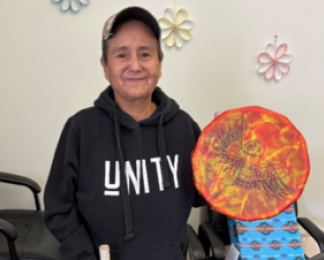

Each Mar. 31 marks National Indigenous Languages Day, a day to celebrate Indigenous languages in Canada. Interior Health (IH) acknowledges National Indigenous Languages Day and honours the voices of the land.

A rich linguistic heritage
IH serves an area with a rich linguistic heritage of diverse Indigenous Peoples preserving traditions and connecting generations. At IH, we honour First Nations, Inuit and Métis and the stories carried through language.
There are 36 First Nation languages in B.C. including several dialects of the Dãkelh Dené, Ktunaxa, Nlaka’pamux, syilx, Secwépemc, St’át’imc and Tŝilhqot’in (Host) Nation languages, plus the languages of Métis, Inuit and Urban and Away from Home Indigenous Peoples.
Why language matters
Indigenous languages are treasures and contribute to the diversity and richness of the linguistic and cultural heritage of Turtle Island. In November 2021, the United Nations declared 2022–2032 the International Decade of Indigenous Languages. The declaration draws attention to the critical loss of Indigenous languages, and to promote and revitalize Indigenous languages worldwide, highlighting cultural importance and supporting language preservation.
Building on that momentum, Canada worked with First Nations, Inuit and Métis partners to developCanada’s National Action Plan for the International Decade of Indigenous Languages. Canada’s National Action Plan provides a framework to further support Indigenous Peoples in their efforts to reclaim, revitalize, maintain, strengthen and promote Indigenous languages in Canada.
Language is integral to Indigenous cultures and histories and considered deeply personal, connecting individuals, families and communities across generations and distances. Language conveys wisdom and traditions from Elders to young people, from one generation to the next.
Indigenous languages considered at risk or endangered
Indigenous languages face threats to their vitality.
In 2021, approximately one in eight Indigenous people reported they could speak one of 70 distinct Indigenous languages well enough to conduct a conversation.
Indigenous languages in Canada are considered at risk, with several being classified as endangered. As documented by the Truth and Reconciliation Commission, this is the result of intergenerational impacts of cultural genocide and discriminatory governing policies, most notably residential schools, and what is referred to the Sixties Scoop. The Sixties Scoop refers to the systems where Indigenous children were “scooped” from their homes and families and put into the foster care system and adopted out to non-Indigenous people around the world.
Today, through the hard work of many, there are signs language revitalization has seen vast improvements, made possible through the funding of language programs, and through the dedicated support of language speakers, mentors and teachers, and language learners. According to Statistics Canada, Indigenous people who reported learning an Indigenous language as their second language rose from 24.8 per cent in 2016 to 27.7 per cent in 2021.
Explore the many ways Indigenous communities are sharing and promoting their languages, oral cultures and linguistic histories through FirstVoices, an interactive language learning resource.
Check out more stories like this
March 31 marks National Indigenous Languages Day, a day to celebrate and honour Indigenous languages in Canada and the voices of the land..
/stories/celebrating-and-honouring-indigenous-languages
Sully is a certified therapy dog who, with his handler Mike, visits patients and staff at RIH bringing comfort and moments of joy to those who need it most.
/stories/we-are-ih-sully-brings-joy-patients-staff-royal-inland
Inspired by her patients and colleagues and driven by a desire to make a difference in people’s lives, Kaitlyn finds daily meaning in her work in pharmacy.
/stories/we-are-ih-pharmacy-leader-grateful-make-difference
Learn about the precautions you can take to prevent tick bites and illnesses, and how to remove a tick on yourself, a family member or pet.
/stories/how-prevent-tick-bites-and-tick-borne-diseases
The KGH Pediatrics team welcomes Dr. Avi Kopstick, a pediatrician and pediatric critical care specialist who until recently was practising in the U.S.
/stories/pediatrician-dr-avi-kopstick-returns-canada-care-mind
Robotic-assisted surgery is allowing doctors perform complex surgeries with less downtime and pain for patients—much to the excitement of surgeons like Dr. Ho.
/stories/vinni-robot-helping-surgery-patients-heal-faster
STAY CONNECTED
Receive news, alerts, public service announcements and articles right to your inbox.