Hospital at Home making a difference in patients’ lives
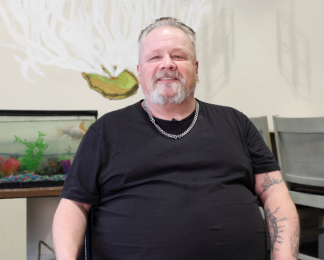
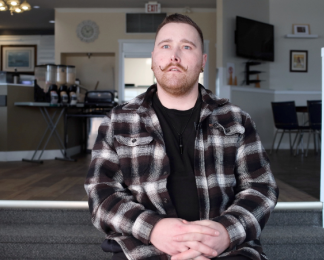
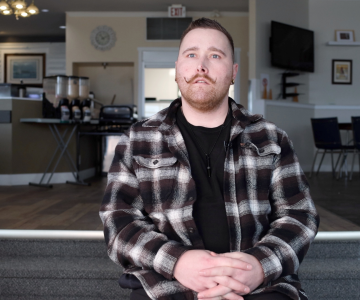
A new program is helping patients like Tim Goode, who spent eight long months at Kelowna General Hospital (KGH) after having a brain tumour removed in February.
Following the surgery, Tim made it home for only a day before returning to KGH by ambulance and being diagnosed with meningitis. This resulted in a few mini strokes, which caused weakness in his left side and required extensive rehab.
“I was right back in the hospital again for several weeks,” he notes.
The tumour at that point had also grown back, requiring yet another surgery.
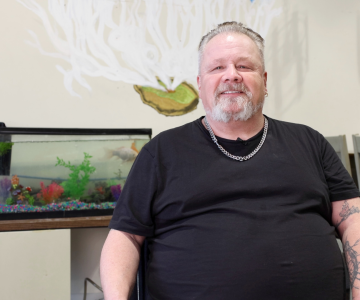
He stayed at KGH until Nov. 15 when he was able to return to his acreage under the new Hospital at Home program.
“It’s an awesome program that we didn’t know anything about,” says Tim, who is now stable and on the road to recovery in the comfort of his own home.
“I’m doing pretty good. I’m mobile. I’ve got the use of my left hand back. Still a little bit weak on the left side, but good,” he says.
‘We’ve seen lots of good successes’
The Hospital at Home program, which has been running since January 2025 in the Kelowna region, is a 24 hour a day service that is designed for acute patients like Tim who still need daily visits and monitoring but are stable.
“We've seen lots of good successes,” says Hospital at Home physician lead Dr. Cara Wall. “We’ve had a few people who have gone home who were just on the cusp of being able to move around, well enough to get from point A to point B. And they've done marvellously.”
Dr. Wall says patients being in their own home is not only good for their comfort but also improves their mental and physical health.
“People who are in Hospital at Home aren’t stuck in their beds and can go to the kitchen for a snack,” she notes. “Had they been in the hospital for another week or month, they would have 100 per cent ended up in short stay rehab.”
Tim, who is one of nine patients currently being cared for under the Hospital at Home program, has noticed an improvement in his physical and mental state since coming back home.
“Oh my goodness. I was so bored in the hospital,” he says. “First day I got home, I was cooking. I’ve got a limited amount of strength, so I have to pace myself, but I was so excited to get home and so happy to be at home. I’m a lot more active and walking around.”
How Hospital at Home works
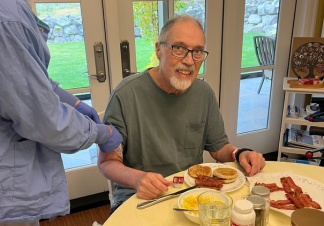
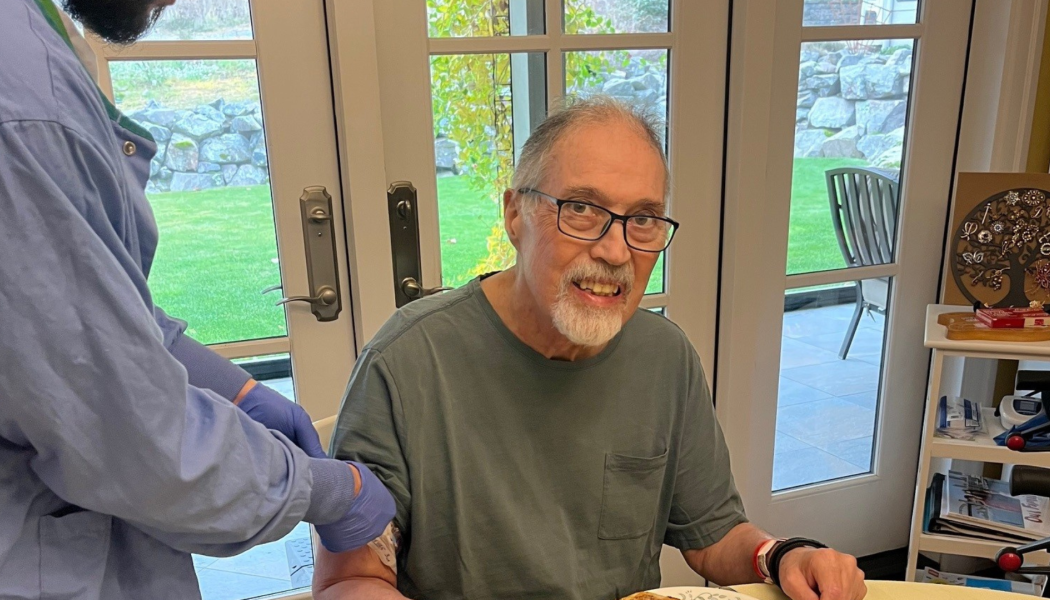
Patients are guaranteed at least one daily home-visit by a nurse. They are also trained to take their own vitals such as heart rate and blood pressure with equipment provided by the Hospital at Home program. A caregiver can also be trained by the staff at KGH.
There is remote patient monitoring: physicians and nurses analyze the results remotely from Kelowna General.
In addition, each patient is provided with a secure medical call bell that is worn around their neck in case of an emergency.
“They can push the button and that will directly link to our charge nurse phone or the phone of their nurse to have immediate direct contact with us,” says program lead Lauren Morrison.
The medical call bell is automatically triggered when there is a fall.
From a physician point of view, Dr. Wall says they can check in with patients in a multitude of ways.
“Once they’re home, we will visit them virtually,” says. Dr. Wall.
Access to virtual care is never a barrier to being a Hospital at Home patient.
“The other way is we’ll actually hop in [the car] with the nurses and go do home visits, which is actually one of the most fun parts.”
An important aspect of the Hospital at Home program is that patients can be brought back onsite to KGH at any time if their conditions worsens or it is no longer safe to provide acute care services at home.
People love home visits
Dr. Wall says people are “tickled” to have a doctor in their home.
“They're like, ‘This hasn't happened since I was a little kid in the ‘50s or, ‘I've never had a doctor in my house.’ So it's pretty neat to be able to be part of that,” she notes.
Lauren says safe, patient-centered care is at the heart of the Hospital at Home program. Health-care staff can truly get to know patients and their families.
“We are welcomed into patients’ homes. If we are thinking about a holistic, culturally safe model of care, we gain a better understanding of the patient's goals, their values, their needs, their family,” she notes.
Hospital at Home freeing up bed space
Aside from close connections with families, Hospital at Home has freed up valuable bed space at KGH.
From its launch January 14 until the end of October, it’s estimated the Hospital at Home program has seen 240 patients and has saved more than 1,800 bed days, meaning space for more critical patients.
Lauren says a program like Hospital at Home is a step into the future and can help take pressure off the health-care system in the Interior.
“Our hospital systems are bricks and mortar. They do an amazing job. But we know there are challenges with capacity. Hospital at Home is a research-based model that is proven effective and we're able to provide safe acute care services within patients’ homes.”
Program eligibility
To be eligible for Hospital at Home, patients need to be at least 17 years old, live within a 20-minute drive of KGH, and be medically stable without the possibility of deteriorating quickly at home.
In addition, Hospital at Home has capacity to support many types of patients, including medical, surgical, trauma and oncology if they fit the eligibility criteria and are deemed safe for the program.
“Some of our proudest moments are supporting new moms in their own homes,” Lauren notes. “They have a medical need that would otherwise keep them in hospital, but they're at home with their family and new babies because of the services.”
It’s understandable that some people might find it comforting to receive care within the four walls of the hospital, but Lauren notes it’s a 24/7 service whenever patients need it.
For his part, Tim says the experience with Hospital at Home and the health-care staff who visit their home have been nothing short of amazing.
“Wonderful people,” he says. “It’s a wonderful program. It enabled me to get home a bit sooner than if they didn’t have it. I’m doing a whole lot better at home than I was at the hospital.”
Check out more stories like this
Tineke was the first policy specialist hired at IH. For two-plus years, she has helped organize many IH policies.
/stories/we-are-ih-policy-specialist-finds-joy-her-role
Recent regulatory changes are making it easier for U.S.-trained lab professionals to find a job in Canada. Attractive benefits make the move north enticing.
/stories/why-us-medical-lab-professionals-are-looking-work-canada
As a doula, Sage Thomas attended a home birth where the family integrated Indigenous ceremonial practices. She’s now practising midwifery in her home community.
/stories/tkemlups-te-secwepemc-grad-offers-midwifery-care-close-home
Thirty-five years into her career with IH, Elizabeth Adolph still loves what she does: taking care of residents at Mountain View Lodge in Lillooet.
/stories/we-are-ih-care-aide-proud-residents-consider-her-friend
In the 5 years since the In Plain Sight report was released, we’ve made strides towards being a culturally safe organization—but there’s more work to do.
/stories/ihs-fifth-plain-sight-response-supports-reconciliation
Inspired by her aunt’s career as a pharmacist, Angela became a pharmacy technician to use the hands-on aspect of compounding to benefit patient care.
/stories/we-are-ih-pharmacy-tech-enjoys-problem-solving-patients
STAY CONNECTED
Receive news, alerts, public service announcements and articles right to your inbox.