Breadcrumb
Medical Staff Response to Patient Concerns
We’re committed to providing high-quality care in a respectful, caring and safe environment. Addressing concerns raised by patients and families with empathy allows us to learn and improve the quality of care for the communities we serve.
Addressing concerns with empathy
Addressing concerns at the time and place they occur offers the best opportunity to rebuild trust and repair relationships with patients.
Medical staff should attempt to address concerns by:
- Acknowledging the patient's perspective while gathering sufficient information to clarify the concern
- Discussing the concern with the appropriate administrative or medical leaders
- Reflecting on the concerns with cultural humility and an awareness of power imbalance, privilege and biases
- Assisting in investigating the concern as necessary
- Communicating the response to the client and answering their questions
- Providing an apology for their experience
- Documenting the investigation, actions taken, and outcomes in the patient's health record
Helpful tips for communicating with patients who have concerns
Apology
As per the BC Apology Act, an apology does not constitute an admission of liability, expressed or implied, or indicate any fault or wrongdoing.
An apology can be provided to the client directly or through the Patient Care Quality Office (PCQO).
An effective apology includes the following:
- A description and recognition of the wrong and an acknowledgement of the harm caused
- Appropriate acceptance of responsibility for the problem
- An explanation of the cause of the problem, or a promise to investigate the cause
- An expression of sincere regret
- An explanation of what you or your organization will do to address the problem
Patient Care Quality Office
Patients who are unsatisfied with the response, or feel unsafe resolving their concern at the point of care, can be provided with an opportunity to escalate their concerns to the Patient Care Quality Office (PCQO). Compliments can also be shared with the PCQO.
The purpose of the PCQO is not to assign fault or blame, but to work with the patient to re-establish confidence and trust with the health system, and to facilitate organizational learning and improvement.
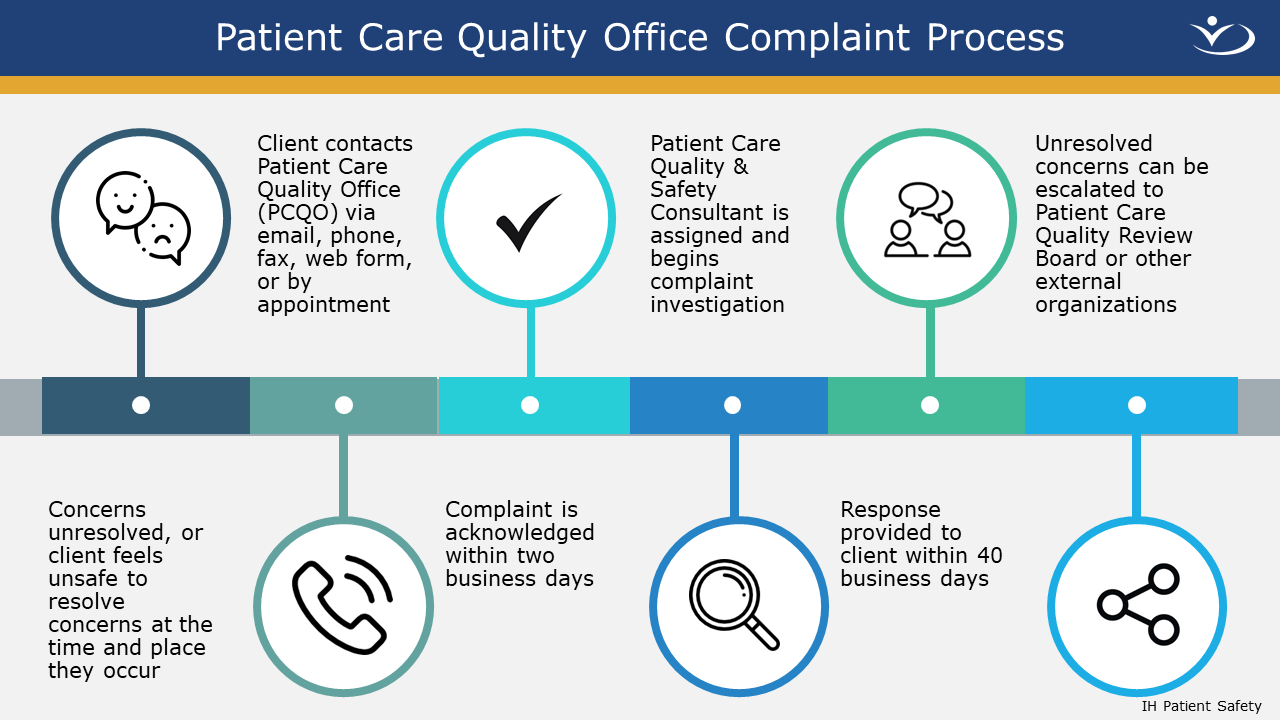
Patients are encouraged to raise questions or concerns about their care to the provider, or that person's manager, at the time and place they happen. For unresolved concerns or for patients who feel unsafe resolving concerns at the time and place they occur, we encourage them to contact the Patient Care Quality Office (PCQO). The infographic below helps medical staff understand the stages of the PCQO complaint process.

A Patient Care Quality & Safety Consultant will conduct an investigation and provide a response within a legislated timeline. Medical staff will be invited to share their perspective with the consultant.
For concerns regarding medical staff conduct, consultants will reach out to the Department Head or Chief of Staff. Concerns regarding professional misconduct will be referred to the appropriate College.
Throughout the process, Indigenous patients can be supported by an Indigenous Patient Care Quality & Safety Consultant within PCQO.
Physicians are welcome to reach out to the Canadian Medical Protective Association (CMPA) for support when responding to concerns.
Unresolved concerns
Patients who are unsatisfied with the PCQO response to their concern can escalate their concern to the Patient Care Quality Review Board. The Review Board is an independent body that may make recommendations to the Minister of Health and the health authorities for improving the quality of patient care and services in B.C.
Patients can also escalate concerns to the BC Ombudsperson or Human Rights Tribunal.
Tineke was the first policy specialist hired at IH. For two-plus years, she has helped organize many IH policies.
/stories/we-are-ih-policy-specialist-finds-joy-her-role
Recent regulatory changes are making it easier for U.S.-trained lab professionals to find a job in Canada. Attractive benefits make the move north enticing.
/stories/why-us-medical-lab-professionals-are-looking-work-canada
As a doula, Sage Thomas attended a home birth where the family integrated Indigenous ceremonial practices. She’s now practising midwifery in her home community.
/stories/tkemlups-te-secwepemc-grad-offers-midwifery-care-close-home
Thirty-five years into her career with IH, Elizabeth Adolph still loves what she does: taking care of residents at Mountain View Lodge in Lillooet.
/stories/we-are-ih-care-aide-proud-residents-consider-her-friend
In the 5 years since the In Plain Sight report was released, we’ve made strides towards being a culturally safe organization—but there’s more work to do.
/stories/ihs-fifth-plain-sight-response-supports-reconciliation
Inspired by her aunt’s career as a pharmacist, Angela became a pharmacy technician to use the hands-on aspect of compounding to benefit patient care.
/stories/we-are-ih-pharmacy-tech-enjoys-problem-solving-patients
STAY CONNECTED
Receive news, alerts, public service announcements and articles right to your inbox.