Explore Stories
Community & Culture
We Are IH is a new recognition campaign to spotlight our people in a real way – through pictures and stories that allow their authenticity to shine through! Each month, four Interior Health employees or medical staff will be featured through our News@IH website and our weekly In the Loop Roundup email newsletter.
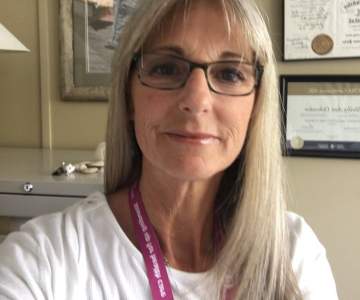
RN Shelley Ockenden is an Occupation Nursing Support Services Coordinator and recent long-term service award recipient after working at the Kamloops health unit for 33 years.
A country girl at heart, Shelley was born and raised on a cattle ranch in Ashcroft, B.C. before spreading her wings and settling in Kamloops where she has lived for the past 32 years.
Shelley followed her passion and love of working with children and their families as she developed her career, supporting children with special health needs and children in palliative care. Although Shelley would fix something for someone if she could, she learned that the best way to "fix" things for people is to imprint a memory of caring, alongside their hurt and their grief.
Shelley created positive change in the lives of the people she surrounded herself with including those within Interior Health. The initiatives she led including the resources she created, Supporting Families through Perinatal Loss Quick Guide and Leaning into Your Discomfort - How to Support Someone Who is Grieving, are a legacy that will continue to help people beyond her time at Interior Health. (Note: links accessible only within IH network.)
Fun is one of the many positive words people use to describe Shelley and we know that with her attitude, each and every day of her retirement will be full of fun!
Shelley wants to thank Interior Health and everyone who has worked alongside her as it's been a very memorable journey.
We will sincerely miss you, Shelley! Thank you for all that you've done! Cheers to an amazing 33 years together, you've touched the lives of so many people and we are so grateful for your service.
Check back each Friday for the next We Are IH feature.
For more information contact EmployeeExperience@InteriorHealth.ca.
Shelley's nomination of Cathryn Goodman keeps the We Are IH loop going:
"Because although she is newer into her role as manager Cathryn has made it a priority (in the time of COVID-19) to really try to get to know and support her team members."

Health & Wellness
Having spent the past 20 years working as a Speech Language Pathologist in Salmon Arm, Christina El Gazzar had been searching for a way to give back to her community.
Originally from Montreal, she had relocated to the Shuswap from northern B.C., accepting a job with Interior Health and moving with her family. For the next two decades, Christina first worked as a frontline Speech Language Pathologist (SLP) and is now a professional practice lead, supporting those in the community with speech and language issues.
But she wanted to do something meaningful for the community. Enter the Salmon Arm Boxing Club’s Hit 2 Fit Challenge.
Christina had already taken up the sport of boxing as a way to get in shape. The club challenge would allow her to share a passion for supporting speech and language development with the community and combine it with the sweet science of boxing.
“The boxing club’s challenge had three elements to it: Get in shape, raise money for something near and dear to you and then you could get in the ring, if you wanted,” explains Christina. “It really checked all the boxes for me. I had been boxing for a few years to stay in shape, but I wasn’t doing it enough. I wanted to do it four or five times a week so I accepted the challenge.”
Finding something near and dear to her heart was easy. She would raise funds to install a communication board at Salmon Arm’s universally-accessible Blackburn Park.
“Young children with communication challenges need support in order to express the most basic of human needs, such as making requests, conveying emotions and socially connecting with others,” she wrote to Salmon Arm council, seeking permission to raise funds and have the board installed in the city park. “Communication happens everywhere. Having a communication board at Blackburn Park will provide these children with the supports they need to be successful in this setting.”
Eight-year-old Connor in front of the communication board at Salmon Arm’s Blackburn Park.
The boxing club’s fundraising gala was to take place in May 2018, which also happened to be Speech and Hearing Month. So Christina went to work with her colleagues and with support from the community to put her plan in action.
Once the city was on board and council had approved, she approached community groups in town, soliciting sponsorship from the Salmon Arm Bulldogs Boxing Club, the Shuswap Community Foundation, Salmar Cinemas, the Salmon Arm Rotary, the City of Salmon Arm as well as the former mayor, Nancy Cooper.
Colleagues and Pediatric SLPs Julie Lewis and Bonnie Johnson came on board to work on the board, establishing the core vocabulary that would help youth communicate. They connected with and received input from various children’s groups in Salmon Arm and raised enough money to have the sign built.
“There are kids with communication difficulties who go to the park and this is something they can use,” says Christina. “It also raises awareness with the public. If they see the board and start talking about it, it reminds us all that there are young people everywhere who struggle with communication.”
Two years to the month that Christina accepted the boxing club challenge, this past May, the communication board was installed at Blackburn Park in Salmon Arm. There are two sides, one for younger kids and one aimed at older youth, who can point to images on the board to aid with communication.
Parent Nadine Kowaski is familiar with the speech language therapists in Salmon Arm. Her son, eight-year-old Connor, has autism and uses a picture exchange system to communicate on his iPad. A similar system of visual cues is used on the communication board.
“Having the board at the park is great,” says Nadine. “It inspires good communication among families that not all kids are verbal. I think it will be amazing, not only to help them communicate, but also bringing about community awareness of kids with diverse abilities with communication. I appreciate their hard work. The speech language pathologists in Salmon Arm are always going above and beyond.”
As for the final part of the challenge, stepping into the boxing ring, Christina also took that on, winning a unanimous decision after three one-minute rounds of boxing, as part of a gala fundraiser night.
“I didn’t decide to get in the ring until close to the gala. It was nerve-wracking. I did it once and am now retired from competition,” she laughs. “I am just thrilled that this project is now completed and can help young people communicate.”
The communication board uses visual cues to allow for enhanced communication for youth with diverse communication abilities.
Side 2.
Health & Wellness
Ryan knew he had a problem. As a teen he had experimented with drugs. That experimenting had quickly escalated into an addiction, and he needed help.
But as a popular boy growing up in a tight-knit community, he was worried about what people would think. Like most of us, Ryan had been exposed to negative stereotypes about addiction, compounded by language like “junkie” and “crackhead”.
“In trying to get support and help in the community, he was very concerned that people would know his secret and treat him badly. He’d grown up hearing those words. He had friends whose parents worked in health care and he was terrified that they would find out,” says Ryan’s mother Sandra Tully, co-chair of Addiction Matters Kamloops.
“I was desperate. I finally convinced him to go to into treatment. I got in touch with the intake nurse and, sure enough, it was someone we knew. I started to cry. I was so happy he could get in and get help, but at the same time I was terrified to tell him she would be there, because I thought then he wouldn’t go. He would be too embarrassed.”
“He went and was so relieved when she just gave him a big hug and told him it was going to be ok. That is what we need.”
Sandra Tully
Sadly Ryan’s battle was short-lived. He died of an opioid overdose at just 22 years old. It was 2016, the year B.C. declared the ongoing overdose crisis a public health emergency. Since then in B.C. more than 4,500 lives have been lost.
“We know that the stigma associated with substance use continues to impact individuals and families, preventing them from reaching out for help and accessing life-saving services and treatment. We also know that language can play a significant role in either perpetuating stigma or ending it,” says Interior Health Practice Lead and Addiction Matters Kamloops co-chair Jessica Mensinger. “One of the easiest things we can do as a community is to consider the words we are using when talking about substance use.”
This is why the Addiction Matters coalition is inviting communities across Interior Health to come together in an effort to use language that is compassionate and non-stigmatizing.
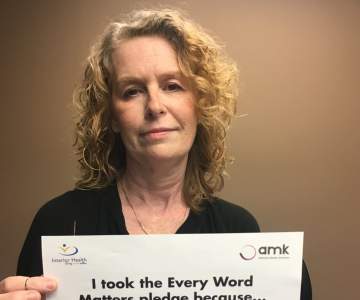
Staff and physicians across IH have been taking the pledge. The team at Southhills in Kamloops was among those to quickly jump on board, challenging colleagues to do the same.Take the online pledge to choose person-first language and language that reflects the medical nature of substance use. Instead of "addict" or "abuser" consider using "person with a substance use disorder." Avoid slang or idioms like "dirty" or "clean" test results and use "positive" or "negative" test results instead. And use language that promotes recovery. Instead of referring to someone as "clean", use "maintained recovery" instead.
IH's Medical Health Officers are among the many teams to show their support.“Words matter. When you say the word ‘addict’, what is the image that comes to mind?” Sandra says. “Substance use can impact anyone. Your best friend could be using substances.”
The Words Matter pledge campaign runs this summer, culminating on Aug. 31, International Overdose Awareness Day.
Visit Addiction Matters to learn more and take the pledge. Download a selfie card to post and share on social media. Invite your colleagues, friends and families to join. Together we can end stigma.
Resources to learn more:
Toward the Heart: Language Matters
BCCDC News Release - Language matters: reduce stigma, combat overdose
Language Matters Infographic
Interior Health videos: Stigma and Substance Use
Government of Canada: Changing how we talk about substance use
Community & Culture
We Are IH is a new recognition campaign to spotlight our people in a real way – through pictures and stories that allow their authenticity to shine through! Each month, four Interior Health employees or medical staff will be featured through our News@IH website and our weekly In the Loop Roundup email newsletter.
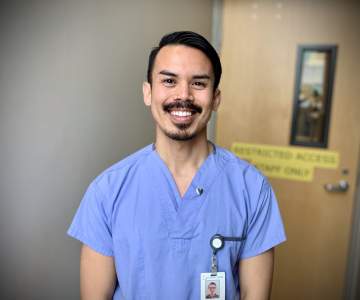
Allen has worked as a Medical Laboratory Technologist at the KGH laboratory for eight years.
You may spot Allen's warm smile and his health-care hero heart pin while he is working hard with his team at Kelowna General Hospital. He genuinely loves the team members he works with and knows that they will support each other, no matter what.
Born in the Philippines islands, Allen moved to Toronto in 1999 with his family and 'bestest' friend, his twin sister.
With the goal of moving to the beautiful Okanagan Valley on his horizon after graduation, he moved cross-country in 2012 to his now home-sweet-home - luckily for us at Interior Health.
A true optimist, Allen sees the glass half full and not half empty. Point in case: When catching up with colleagues after they have traveled abroad, he seeks some of their international cash to keep in his wallet as a reminder to travel to that destination. Maybe if they're lucky he will bring them back a little token of his appreciation!
"Be kind, calm and safe." - Dr. Bonnie Henry
Allen's favourite inspirational quote
Truly inspired by the power of the microscope enabling him to see what he couldn't with his bare eyes, at work he glimpses another world of red and white blood cells, tissue cells, bacteria, viruses and much more. Young Allen was fascinated by seeing these tiny little things interact and communicate. From his first look at an amoeba under the microscope, he was mesmerized and thrilled seeing it swimming in the water.
From the entire team at Interior Health, we thank you for all that you do, Allen, and we are so thankful that you chose Kelowna and Interior Health to make your home-sweet-home.
Check back each Friday for the next We Are IH feature.
For more information contact EmployeeExperience@InteriorHealth.ca.
Allen's nomination of John Bors keeps the We are IH loop going":
"John is a joy to work with and creates a positive work environment. He’s a kind, dedicated hard worker who remains calm under pressure and is very knowledgeable. We are incredibly grateful to have someone like him working in the laboratory. He’s very good at trouble shooting the instruments and liaising between the lab and our vendors. He’s very patient and gets the job done."
Community & Culture
Think volunteering is just a nice thing to do for others? Think again.
A growing body of research has pointed to the social, emotional, and even physical health benefits of contributing your time and energy to your community as you age.
Benefits to older adults
A study published in the The Gerontologist journal found that volunteers reported significant improvements in their mental health, along with other benefits ranging from a greater feeling of productivity, increased social activity, and an overall sense that their life had improved.
Research shows that social interaction supports overall physical, mental and emotional health and helps maintain brain health. People with strong social networks say they feel happier and more supported. Older adults also report increased levels of satisfaction and overall improved quality of life when they are engaged with their communities and feeling connected. Many find this through volunteering and staying active and engaged in their communities.
How communities benefit from older adults
It is hard to imagine our country without volunteers. Volunteers are active in youth clubs, arts programs, helping newcomers settle into their communities, visiting elderly people, and providing aid and comfort in hospitals. Without them, Canadian communities would be very different. According to a report on volunteering, one quarter of all volunteers in Canada are those 65 and older.
What are they giving? In addition to the unique skills each person possesses, older adults offer their time, their career and life experience, and their wisdom and perspective
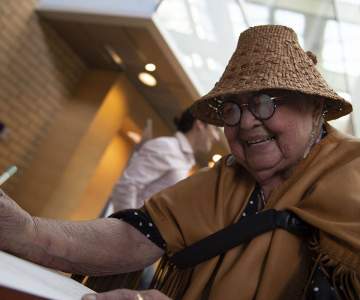
After her retirement as a registered nurse in Vernon, Jessie Nyberg, a Shuswap Elder from the Canoe Creek Band, began working as a volunteer at the Vernon Friendship Centre. She advocated for improved diabetes services and better access to early childhood development programs in her community.
Today, Jessie is an Elder advisor on a UBC research grant which explores how Indigenous people experiencing diabetes and obesity access care. She also raises awareness of B.C.’s Head Start pre-school programs, particularly among Indigenous people in her community. And she sits on a consortium that represents programs that serve Indigenous children with disabilities.
As the seniors navigator for the Golden Community Resource Society, Mickey Balas has a wealth of knowledge about resources in her community and is a tremendous advocate for older adults in the Golden area.
They offer the priceless ability to provide perspective and guidance on an infinite range of topics and activities. Seniors are able to devote the required time and effort to see projects through from start to finish. Because they are often no longer constrained by a need to conform to the opinion of others, many seniors tend to be candid and direct in sharing their opinions. Seniors realize their needs can be intergenerational and what benefits them will also benefit the rest of society.” Mickey Balas, seniors navigator
“In my experience, communities benefit from the participation of seniors in many components of our society,” says Mickey. “Seniors bring and share a wealth of information and experience gained throughout their lifetimes.
Barriers to older adults giving back in the community
For senior citizens, the pandemic brings another blow: their usual volunteering activities have been put on hold because of the risk they face if they contract the virus.
Volunteers are important partners in health-care, says Kristin Cleary, volunteer coordinator at Interior Health.
“The majority of our long time volunteers are older adults and are most at risk for COVID-19. So having to suspend volunteer services has been really hard on both the volunteers as well as the clients who receive that time with them. We are having to adjust and look at creative new ways to help out our community.”Kristin Cleary, volunteer coordinator
Stigma and stereotypical attitudes towards aging can also be a barrier to seniors participating in their communities.
“Some older adults are influenced by the misconception of their value in their later years, for example: coaching with sports that they previously played or in which they were once involved,” says geriatric nurse specialist Shannon Paul-Jost. “Others feel frustrated at the attitudes of others present within their community. There are circumstances where these judgments do not align with their lived experience and older adults may avoid contributing to groups, as they may not feel their contributions are understood and appreciated.”
Older adults have a wealth of lived experience and can contribute to their communities by shaping conversations to be more inclusive and age-friendly, which is a unique perspective that can only be had through years of living, says Shannon.
“Let’s challenge our own thoughts and attitudes about aging. When it comes to community contribution and collaboration, I believe we all benefit from being more open-minded, compassionate and thoughtful.”
Featured image photo courtesy UBC Okanagan.
Caption: Jessie Nyberg signs a Truth and Reconciliation commitments at a special UBCO ceremony - just one example of the tremendous contributions of this active Elder and others like her.

Health & Wellness
Temperatures within the Interior tend to soar mid-summer, when residents and visitors enjoy fun in the sun.
However, too much heat can be harmful to your health. Overheating can lead to weakness, disorientation and exhaustion. In severe cases, it may lead to heat stroke (also known as sunstroke). And heat stroke is a life-threatening medical emergency.
“I know we’re all busy taking precautions to prevent COVID, but in addition we need to stay safe from the heat."Medical Health Officer Dr. Carol Fenton.
Here are some tips to keep you safe and healthy this summer.
10 Steps to avoid heat related illness
Plan your outdoor activity before 11 a.m. or after 4 p.m., to avoid the most intense sun.Drink plenty of non-alcoholic fluids. Water is the best choice.Avoid physical work or exercise outside in the heat of the day.If you must work or exercise outside, drink two to four glasses of water each hour, even before you feel thirsty.Rest breaks are important and should be taken in the shade.Apply sunscreen to prevent sun burn, but remember this doesn’t protect from the heat.Stay in the shade, or create your own shade with lightweight, light-coloured, loose-fitting clothing, a wide brimmed hat, and/or an umbrella.If you’re struggling to keep cool, move indoors to an air-conditioned building or take a cool bath or shower. At temperatures above 30° C (86°F), fans alone may not be able to prevent heat-related illness.Never leave children or pets alone in a parked car. Temperatures can rise to 52° C (125° F) within 20minutes inside a vehicle when the outside temperature is 34° C (93° F). Leaving the car windows slightly open will not keep the inside of the vehicle at a safe temperature.Regularly check older adults, infants and children, those doing a lot of physical activity or working outside, and people with chronic disease or mental illness for signs of heat-related illness. Make sure they are keeping cool and drinking plenty of fluids. Check on those who are unable to leave their homes, and people whose judgment may be impaired.
https://youtu.be/4sVYjq86hXA
The symptoms of heat-related illness can range from mild to severe. They include:
pale, cool, moist skin (early stages); or red, hot, dry skin (in the late stages of heat stroke);heavy sweating;muscle cramps;rash;swelling, especially hands and feet;fatigue and weakness;dizziness and/or fainting;headache;nausea and/or vomiting;fever, particularly a core body temperature of 40° C (104° F) or more;confusion and decreased mental alertness;hallucinations;seizures; andunconsciousness/comaWhen recognized early, most mild heat-related illnesses can be treated at home. Home treatment for mild heat exhaustion may include:
moving to a cooler environment;drinking plenty of cool, non-alcoholic fluids;resting;taking a cool shower or bath; andwearing lightweight clothingIf your symptoms last longer than one hour, change, worsen or cause you concern, contact a health-care provider.
Resources
For more information on heat-related illness, visit the HealthLinkBC website or dial 811.
For local governments: Heat Alert Response System

Health & Wellness
Summer is here. So is COVID-19.
During these warm, sunny days, we want to get together with family and friends for camping, barbecuing, and other activities. There are ways we can enjoy these activities and stay safe.
Here are the top 10 ways to socialize safely:
Sick? Stay home: If you are feeling unwell, even with mild symptoms, stay home and get tested.
Fewer faces in bigger spaces: Limit your gatherings to small groups of people you know.
Outdoors is better: Enjoy the summer weather and protect your home – socialize outside and maintain physical distancing as much as possible.
Smaller is better: Gatherings with close friends should be limited to six people or fewer, especially when you’re indoors.
Keep your bubble small: Avoid crowded, closed spaces as much as possible. The more people you interact with closely, the higher risk you will be exposed to COVID-19.
Have a designated contact keeper: If you host a gathering, keep a list of your guests and their contact information. This will help Public Health be in touch with contacts more quickly if there has been a COVID-19 exposure.
Keep your distance: Maintain two metres (six feet) between you and other people who aren’t in your bubble.
Mask up: Wear a mask when you’re in public and physical distancing isn’t possible. This lets others around you know you’re staying safe during this pandemic and that you’re keeping them safe as well.
No sharing: Don’t share food, drinks, or cigarettes with others. This summer is about “bring your own” and not potlucks.
Practice good hand hygiene: wash your hands often with soap and water for 20 seconds.
Practice safe socializing
This video illustrates how the steps above can slow the spread of COVID-19.
Practice safe socializing
Research & Innovation
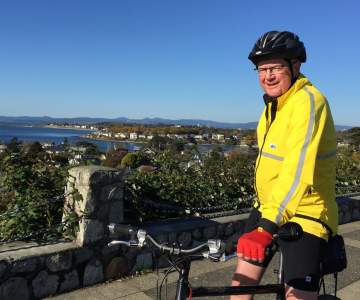
In 1978, just beginning his medical career, Dr. Bruce Nicolson agreed to a six-month term to work in 100 Mile House as a locum.
At the time, he had been practicing as a physician in New Zealand and Australia, and training in rural health care, but he was familiar with the 100 Mile House area. Born and raised in Port Coquitlam, as a child Dr. Nicolson had camped and fished in the Cariboo with his family.
A trip back to the Cariboo as a young physician was in the cards.
What Dr. Nicolson would find after six months of rural medicine would keep him practicing in 100 Mile House for more than four decades, taking a keen interest in improving outcomes for his patients.
This year he was honoured for a lifetime of providing exceptional care, being named one of three 2020 BC Rural Health Award Lifetime Achievement recipients.
“I have to say there are some really wonderful physicians in 100 Mile House. I’ve learned a lot from them and any number of them would be as deserving as me,” Dr. Nicolson says of the award. “I feel very honoured to receive it but I can’t say that I stand out that much from many of my peers.”
The scope of practice in rural medicine is what sparked the interest in Dr. Nicolson early in his career, providing a wide variety of cases one might not see in a bigger centre. However over the years it’s been the support he has received in the community, and from his colleagues, that has meant the most to him.
“The warmth and appreciation that is so much a part of being in a rural community,” is a major attraction, according to Dr. Nicolson. “The thing that really kept me going is the collegiality that rural communities have with their physicians. You are very well accepted and get a lot of positive feedback from the community.
“I’ve always felt so much support from my colleagues. As a physician, sometimes you run into a rough patch with your cases and I could always reach out to the men and women I worked with. I always knew they had my back. It is very much a team thing that takes place.”
During his medical career, Dr. Nicolson has practiced continually in 100 Mile House, except for two sabbaticals for training, providing both office-based and emergency care, surgery, anesthesia and obstetrics. He’s delivered many children in the area over the years.
“It’s gone by so fast, sometimes I scratch my head,” he says. “I’m in the situation where I have delivered babies and then I have delivered babies from the babies I delivered. I just think ‘how did it go by so fast?’”
Throughout his career, Dr. Nicolson has travelled regularly to White Feather Clinic at the Canim Lake reserve to provide closer to home care for this remote population. He was one of the first physicians to add a nurse practitioner to his clinic and has served multiple terms as Chief of Staff of the 100 Mile District General Hospital.
A father of five, he is one of the founding members of the Central Interior Rural Division of Family Practice and helped lead the local deployment of ‘A GP for Me’ an initiative to attach patients to a local primary care provider.
Health & Wellness
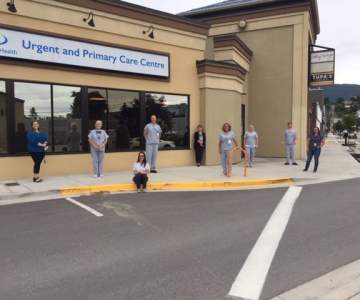
The old saying that the whole is greater than the sum of its parts – in the case of Interior Health’s Urgent and Primary Care Centres, where individual health care professionals work together in close collaboration to support the needs of patients, that couldn’t be more true.
Here, teams of health-care providers that may include family physicians, nurse practitioners, registered nurses, physiotherapists, social workers, and medical office assistants provide urgent and primary care for people, particularly those who may not have access to a family doctor or nurse practitioner, giving them access to care when they have health concerns that need to be seen within 24 hours but don’t require a visit to an emergency department. These team players all bring their individual knowledge of the health-care system to the table. Collectively, that’s a powerful resource.
And a valuable one in the midst of the COVID-19 pandemic, which added new uncertainty and new complexities for some people. As businesses closed out of concern for transmission of the virus, some people were unable to access some of their most basic health-care needs, and many of them turned to UPCCs for solutions.
“I remember one elderly woman who needed blood glucose monitoring strips for her diabetes – they weren’t available elsewhere. The team was able to call our diabetes educator and partner with a pharmacy to get her strips,” recalls Allison MacInnes, North Okanagan Primary Care coordinator who is currently overseeing the Vernon UPCC, which originally opened in October 2019 within the Vernon Downtown Primary Care Centre, but relocated to a new standalone location at 101-3105 28th Ave. on March 31 – right at the height of the COVID-19 crisis.
Allison says it’s because of the team of clinicians gathered at the Vernon UPCC that they’ve been successful in bridging the gaps for patients needing primary care. In addition, for people without a regular physician or nurse practitioner, they’ve ensured there is a connection to ongoing care beyond their visit to the UPCC through attachment to a primary care provider.
“The team comes from all parts of Interior Health and the community, and they know how to link people with the care they need,” she says, adding that team members share their breadth of knowledge at their morning huddles – and watching them in action is, in itself, poetry in motion. “It’s all about how can we provide wraparound services for that patient, now and in the days ahead? It’s really cool to see how caring they are.”
Six UPCCs now open
The Vernon UPCC is one of six now open in Interior Health – the others are in Kamloops, Kelowna, Castlegar, West Kelowna and Penticton. All of them offer team-based, urgent and primary care for all residents in their communities. But all four UPCCs also differ in key ways – because each was developed through collaboration with community partners, in particular the Divisions of Family Practice and Aboriginal communities, with a focus on providing services that would meet the specific needs of that region.
In Vernon, that means there is now an option for urgent and primary care for people who, because of their circumstances, would otherwise find it difficult to connect with a physician or nurse practitioner through the more traditional avenues of care. As part of the UPCC planning, which was supported by the Shuswap North Okanagan Division of Family Practice, local physicians highlighted the need for support for people experiencing homelessness or other social barriers to care, including mental health and substance use issues. The team at the Vernon UPCC was then strategically design
ed to include professionals with the skills to meet the unique needs of this population, including social workers and mental health and substance use clinicians. The Vernon UPCC has provided care for 5,578 patients since opening, and a total of 819 people are now connected to the UPCC primary care team for ongoing care.
The Castlegar UPCC opened April 6 at the Castlegar and District Community Health Centre. It’s the first UPCC in Interior Health developed using a rural model, with services that are closely located to and integrated with an emergency department – in this case, the emergency department at the Castlegar Health Centre. This integration allows local family physicians, who also support services at the Health Centre (including the emergency department), to become part of a primary care team at the UPCC. This model of care ensures the stability of existing health services, and expands access to urgent and primary care services for people living in Castlegar. In the short time it’s been open, the Castlegar UPCC has already seen 522 patients and connected two people to a local primary care provider for ongoing care.
The Kamloops Urgent Primary Care and Learning Centre (UPCLC) opened in June 2018 – B.C.’s first urgent and primary care centre. In Kamloops, many people are without a regular family physician or nurse practitioner, so the focus of this centre is two-fold – providing urgent care for people living in the Kamloops area, whether they have a primary care provider or not, and connecting those who don’t to ongoing regular care. This connection is made through the 8-1-1 Health Connect Registry, a centralized waitlist established to help link people to new providers. While they wait to be connected, their primary care needs are met through the UPCLC – it has had 34,525 patient visits since opening. Also unique to Kamloops is the partnership developed with the University of British Columbia’s family medicine resident training program that sees resident doctors working under the supervision of experienced physicians, allowing them an opportunity to start building a practice locally – there have been 1,044 people connected to the UPCLC from the 8-1-1 registry who are now able to receive ongoing are from physicians there.
The focus of the Kelowna UPCC, which opened in December 2019, is similar to that of Kamloops – providing timely access for people to urgent and primary care when they need it. In addition, the Kelowna UPCC provides ongoing primary care for patients as they wait to be connected to a family physician or nurse practitioner – so far, 1,167 patients have been temporarily attached in this way. In Kelowna, that connection is made through the Central Okanagan Division of Family Practice’s Find a Family Doctor Program. Further, the UPCC team in Kelowna has developed primary care services that align with and augment the services already established by local practitioners in the community, and have done so in a clinic that is centrally located and has accessible transportation options for young families, older adults, and students. Since opening in late December, more than 7,726 patients have visited the Kelowna UPCC.
Health-care partner collaboration creates a tailor-made approach for communities
In all four cases, collaboration with local partners was key, says Jason Giesbrecht, IH’s Executive Director of Primary Care Planning.
“Whenever we are able to work with partners, in particular local Divisions of Family Practice and Aboriginal communities, we are finding local solutions to local needs. We are hearing directly about what is needed most in their communities,” he says. “Their feedback has helped us strengthen our health-care partnerships, while increasing access to quality care in our communities. It’s exciting work.”
Planning is currently underway for future UPCCs in Interior Health.
Visit Interior Heath’s website for more information on IH’s Urgent and Primary Care Centres.
-
Load More
Showing 792 of 836
Sign up for email updates