
How SLPs help babies and children find their voice early in life
Your child’s first word is one of those moments that’s written down, caught on video and remembered well into their adulthood.
But did you know before—and long after—that celebratory milestone, there are a lot of other speech and language milestones a baby will reach? In the first year of life, your baby has so much to tell you and is such a good communicator, even if they’re not talking yet. Up to about two years of age, your baby’s speech and language skills are evolving rapidly. Skills continue to advance until five years old.
Not all children develop at the same pace, however. If your instincts are telling you something is amiss, listen to them and reach out to a speech-language pathologist.
One family’s speech-language journey
It was at Maria’s son Liam* 18-month vaccination appointment and screening when the public health nurse noted that his verbal skills weren’t as advanced as they should be.
“We were noticing that it was really hard to figure out what he wanted,” recalls Maria. “He would get upset and unregulated when he couldn’t express what his needs were or what was bothering him. It was hard to comfort him when I didn’t know what was upsetting him.”
The family’s health-care providers recommended Liam be assessed for autism spectrum disorder (ASD). While waiting for an assessment, Liam met with Gabrielle (Gabby) Schley, a speech-language pathologist with Interior Health’s (IH) Early Childhood Development Speech and Language Services.
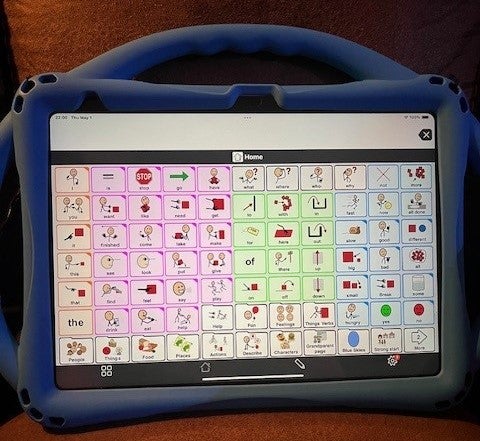
Liam continued to see Gabby for more than a year. “We tried a few speech and language strategies for a year with limited results,” says Maria. “He made some progress verbally but was still severely delayed. After his ASD assessment, we started talking about trying an augmentative and alternative communication device (AAC) to communicate more effectively. I had heard of them but didn’t know someone as young as Liam could benefit.”
With autism funding from BC Family Services, the family purchased an iPad with Proloquo2go software. “Liam took to AAC very quickly. He can now ask for specific items, like food or a toy, and express his feelings,” Maria explains. “He’s also picking up words through verbal communication. We incorporate the device into everyday activities.”
Gabby has also done sessions with Maria’s extended family, so they feel comfortable with the device. While Maria admits that they sometimes get the odd look in the grocery store when Liam is using his device, she’s been steadfast in educating those around her.
Maria also shares this advice with parents: “If your child has speech and language delays, don’t give up. Something might work for a while, and then you’ll have to try a new intervention. Work with your speech language pathologist, who can advise you on different approaches.”
* Names changed to protect the family's privacy.
Helping young children develop strong communication skills
Gabby has been a speech-language pathologist (SLP) for seven years and has been with IH for three. SLPs like Gabby focus on helping children ages 0–5 develop the communication skills they need to express themselves, understand others, and interact with the world around them.
“It might be surprising to learn that speech and language skills are more than vocabulary, pronunciation and comprehension,” explains Gabby. “Gestures, hand signs, eye contact, attention, imitation and turn taking are all building blocks of human communication.”
“In early intervention, we get to work at the heart of where change begins—supporting families and helping little ones find their voices from the very start. I chose early intervention because it’s about prevention, not just treatment. Supporting communication development early sets the stage for confidence, connection and learning for life.”
In communities across IH, a team of SLPs works with families and caregivers to support children’s communications in everyday routines. Our speech language pathologists help with pronunciation, language comprehension and use, social communication and voice, and hearing or stuttering problems.
Clients start with an initial visit during which their child’s background, strengths and weaknesses are assessed. It’s during this session where the SLP determines if a child is developing as expected or if the child would benefit from intervention services.
“There’s something incredibly powerful about helping a child say their first word or seeing a caregiver light up when they connect with their child in a new way.” remarks Gabby.
If services are needed, they can be a combination of individual sessions, group sessions or parent coaching. Most sessions incorporate some coaching to help parents facilitate their child’s language at home. “I strive to give parents and families the tools they need to help the child be successful. We work a lot of building skills through play,” shares Gabby.
"I think what’s important for a family to know is that you can reach out to us no matter how young their baby or child is,” she adds. “And you don’t need a doctor’s referral to meet with a speech-language pathologist.”
“From the time he was around a year old, I noticed Jack wasn’t responding to his name or making eye contact. Fast forward two years. Jack started preschool, and the educators immediately recognized he needed help. They suggested a referral to a speech language pathologist and for the first time I felt like someone was seeing my perspective.
I didn’t wait to hear back about my referral. Instead, I contacted Interior Health directly as I knew that we had an SLP in 100 Mile. From our first meeting, Gabby took my concerns seriously. She guided me through the paperwork for autism testing and provided me with extremely useful strategies to help Jack communicate effectively and manage his emotions.
One aspect that truly set Gabby apart was her compassionate approach to Jack’s emotional challenges, particularly his attachment to Woody from Toy Story. With help from her co-worker they created “pocket pals” that he could clip to his shirt and take a picture of his favourite pals with him everywhere on a pull string. They also created beautiful stories about sharing and keeping Woody safe at home.
What meant the most to us was feeling heard and supported. Gabby’s encouragement and expertise have helped Jack not only to improve his communication skills but also flourish as a confident individual. We are so thankful for her dedication as an SLP and the positive impact she has made in our lives. I cannot express enough gratitude for the support Gabby has provided my son, Jack, through his ongoing speech development journey.”
Speech language resources
IH offers more than a dozen pamphlets on speech and language. Topics include milestones, stuttering, checklists, and gestures and signs. You can even download a referral form.
If you have any concerns about your baby or child’s speech and language development, contact the health unit closes to you.
May is Speech & Hearing Month in Canada! This month, Speech-Language & Audiology Canada shines a spotlight on communication health and the work of SLPs and audiologists.
Check out more stories like this
Cottonwoods Care Centre coordinator Lia Sambrielaz has been sharing small acts of kindness at IH for 37 years.
/stories/we-are-ih-coordinator-motivated-help-long-term-care-clients
Our 9-part video series teaches about the purpose and importance of advance care planning (ACP) and why it gives peace of mind to you and your loved ones.
/stories/lets-talk-about-advance-care-planning-your-voice-your-choice
A funding initiative is helping the Cariboo Chilcotin Métis Association (CCMA) grow food security in ways that reflect knowledge, culture and community needs.
/stories/funding-helps-williams-lake-metis-community-support-food-security
Meghan Johnston became a registered psychiatric nurse after watching people struggle to navigate the health-care system and witnessing the barriers they faced.
/stories/we-are-ih-psychiatric-nurse-finds-meaning-crisis-team-role
Jasmine Mingaud found relief and stability after connecting with the Central Okanagan PCN where a team helped her manage chronic pain and life challenges.
/stories/how-primary-care-team-changed-one-womans-chronic-pain-journey
Behind every appointment, lab test and medical imaging test are a complex set of processes. A small but mighty team is transforming how that work gets done.
/stories/saving-time-improving-patient-care-intelligent-automation
STAY CONNECTED
Receive news, alerts, public service announcements and articles right to your inbox.