IH prepares for wildfire season long before the smoke arrives
Wildfires are increasingly impacting our lives in the Interior. In this four-part series titled "At the Ready: Stories of Wildfire Response and Recovery", learn how Interior Health prepares for events like this summer’s destructive wildfires, and how we respond to deliver care, protect staff, and keep people healthy and safe when emergencies occur.
When wildfire season arrives in the Interior, our attention naturally turns to the flames: where they are burning, which communities are under evacuation orders and what residents should do to stay safe.
However, long before a wildfire threatens a community, Interior Health (IH) has already been preparing.
That preparation proved invaluable this summer, especially with the fast-moving Bald Range wildfire in Summerland.
For IH, wildfire preparedness is not a single plan pulled from a shelf each summer. It is an ongoing process shaped by years of experience, regular training, exercises, inventories and relationships with partners across the region.
“We build on our lessons after each and every climate event,” says Brent Hobbs, IH’s program director, Patient Access, Transport and Emergency Response. “We've got a lot of experience, and we do an after-action review every year at the end of the wildfire season.”
Those reviews help identify what worked, what could have gone better and what needs to change before the next emergency.
“So our processes get stronger,” Brent notes.
Preparation starts in the spring
As wildfire season approaches, IH reviews procedures and makes sure people understand their roles before they may have to act under pressure.
One of the key pieces is Code Green, IH’s evacuation procedure.
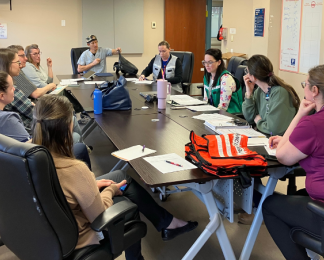
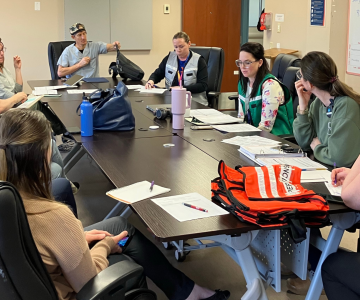
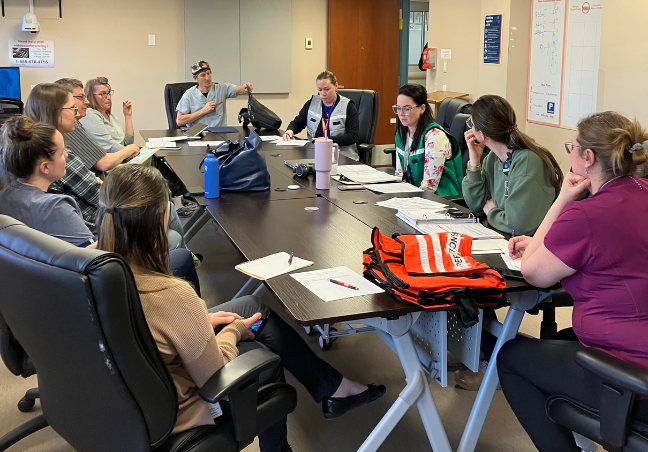
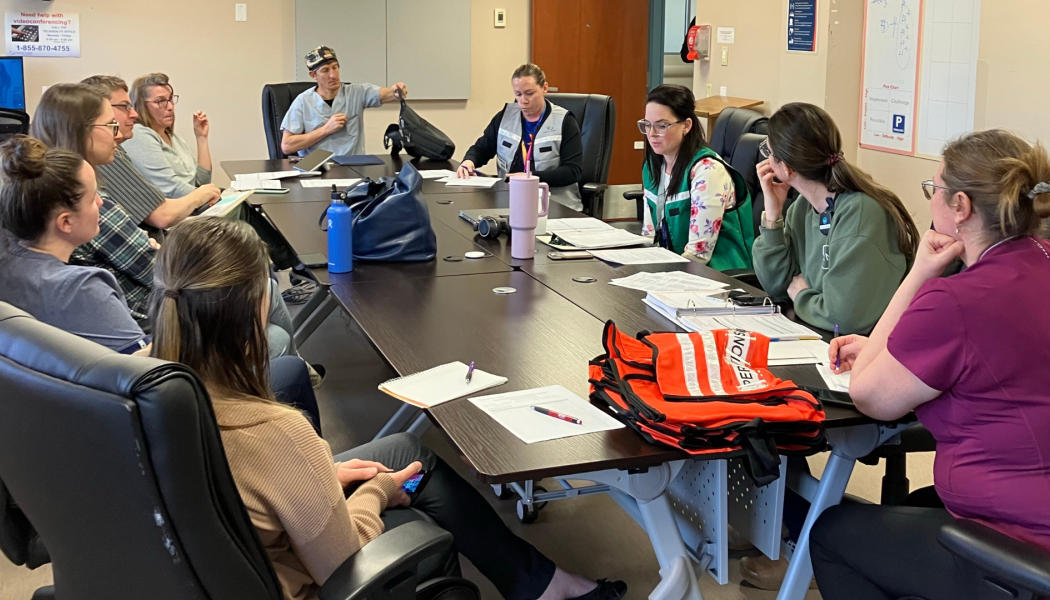
Every spring, leaders and frontline clinicians who could be involved in an evacuation review the procedures and how they would function within an Incident Command (IC) or Emergency Operations Centre (EOC) structure.
“This is critical because everyone is then aware of their roles when an emergency hits,” Brent says.
Tabletop exercises, conducted by Health Emergency Management BC (HEMBC), are built into those sessions using realistic scenarios to help teams think through decisions before they are faced with an actual emergency.
The preparation extends across IH.
There’s the patient safety side of preparation, and there’s also caring for your staff and making sure they stay safe in an emergency and understand procedures and processes.
For long-term care sites, it includes ensuring evacuation lists are current and identifying potential receiving sites.
Karen says care facilities such as hospitals are evacuated only as a last resort, but they still need plans in place.
IH also updates evacuation information for people supported through services such as Home Health and Mental Health and Substance Use (MHSU).
“Ultimately, it’s about understanding and knowing where your vulnerabilities are in each of the communities you support and knowing that you've got plans ready should you need to activate them,” Karen says.
Deploying extra beds and equipment to support patients
For IH's director of protective services Andrew Pattison, preparation also means having a detailed understanding of the resources IH has available when an emergency begins.
“The big thing that we do is make sure we know what’s available, and where it is,” Andrew says.
That includes beds and supplies, as well as equipment such as air scrubbers that can be important when wildfire smoke affects indoor air quality.
IH has strategically positioned shipping containers, located in Kamloops and Kelowna, full of beds and supplies that can be sent when and where they are needed.
The same principle applies to the nearly 300 spare beds IH maintains across the region.
“The key is that the supplies are geographically dispersed,” Andrew says.
That geographic distribution provides flexibility if one community or region is affected.
For example, when Kimberley’s long-term care home was evacuated during the Matthew Creek fire, Andrew says capacity in the East Kootenay area was used while beds in the Kootenay-Boundary and other regions were available in case the situation worsened.
During the Big Bar Complex fire that impacted Clinton and the Cariboo region, IH was able to begin moving beds in anticipation of possible evacuation orders, creating additional capacity elsewhere.
But maintaining a reserve of equipment comes with a practical challenge. Health-care facilities have limited storage space, meaning preparedness requires balancing emergency capacity with the realities of operating facilities every day.
Planning for the safe movement of patients & people needing extra support
One of the most challenging aspects of a health-care evacuation is transportation.
Teams may need to move hundreds of people, many of whom are frail or have complex health needs, in a short period of time.
IH works with both public and private transportation partners, including BC Transit, BC Ambulance Service, volunteer driver services and contracted stretcher providers.
“We have a group called Interior Health Patient Transport Partners, and we have a ‘bat signal’, if you will, that we test several times every spring,” Brent says.
The exercises are intentionally realistic. Partners receive an emergency message outlining a wildfire’s location, its proximity to health facilities and the approximate number of patients who may need to be evacuated. They then determine how many resources they could provide immediately.
Years of experience have also changed how IH approaches evacuating long-term care facilities.
A facility facing a sudden evacuation may be focused on getting its residents ready and may not have the resources nor experience to coordinate a complex transportation operation at the same time.
IH’s High Acuity Response Teams (HART) help fill that gap.
“We need transport captains at the site to help triage which patient will go into which transport resource,” Brent says.
The teams also help make sure patients are stable for the journey.
During the Summerland response, teams from Kelowna and Penticton were able to go directly to the facilities and work alongside staff to coordinate the evacuation.
“Without that, we wouldn't have been able to do it in such a timely manner,” he says.
It’s another example of how lessons from previous emergencies have become part of standard preparedness.
Preparing for a fire that may happen somewhere else
Wildfire planning also means preparing for scenarios that may not ultimately happen.
Karen recalls one example in which receiving sites in the North Okanagan were established weeks in advance because IH was preparing for a potential evacuation from 100 Mile House.
Logistics teams moved in, beds were brought in and the sites were prepared to receive patients.
Ultimately, the evacuation trigger occurred somewhere else, but preparation like that is needed with the rapid increase in wildfire activity in recent years.
I think it’s not a matter of if anymore, but when. This year showed us how fast fires can move.
Preparedness beyond care facilities
Wildfire preparedness also extends beyond IH’s hospitals and care facilities.
Environmental health officers, including health inspectors and licensing officers, work with operators before wildfire season, including water systems, child-care facilities, long-term care homes and restaurants.
Part of her team’s important work is to help operators think through how they will continue to operate safely during an emergency.
“What are you going to do when you’re near a wildfire? What’s your plan if the power goes out for two or three days? How are you going to operate if you’re on a boil water advisory and you can’t use the water?” says corporate director of environmental public health Courtney Zimmerman.
Ready before the next fire
There will always be uncertainty during wildfire season.
We cannot control where a fire starts or how quickly it moves. What we can do is prepare.
That includes reviewing evacuation procedures each spring and learning from past seasons, practising emergency roles, testing transportation plans with partners, maintaining spare beds and critical supplies, and fostering the relationships that allow people and resources to come together quickly.
The work happens largely out of public view.
But when the smoke arrives, those preparations become visible in IH’s ability to move patients, support communities and keep people safe.
As Brent says, successfully evacuating patients, caring for them while they are away from their homes and returning them safely and compassionately “does not happen by accident.”
Check out more stories like this
For IH, wildfire preparedness is shaped by years of experience, regular training, exercises, inventories and relationships with partners across the region.
/stories/ih-prepares-wildfire-season-long-smoke-arrives
IH’s CMH redevelopment team travelled around Cariboo to reconnect with Indigenous communities and share how their input is shaping the hospital's new building.
/stories/closing-circle-indigenous-communities-shaping-future-cmh
Chris Turner turned to addiction as a teenager, but through his recovery has become a mentor to give hope to others battling addiction.
/stories/what-worked-me-chriss-focus-daily-skills-helps-recovery
Find tips for walking, biking or rolling to school safely. Learn how to make it safer to travel to school in your community.
/stories/how-walk-bike-or-roll-school-safely
For Kelli Hartman, nursing was never just a career choice. It was a calling. What she didn't expect was where that calling would take her.
/stories/we-are-ih-retired-nurse-still-makes-difference-long-term-care
What worked for Saras addition recovery was the connections and relationships she formed at IH that changed her life.
/stories/what-worked-me-saras-journey-surviving-living
STAY CONNECTED
Receive news, alerts, public service announcements and articles right to your inbox.